Standing Desk

My New Year’s resolution for 2013 is to get right with my back, so yesterday I converted my workstation into a standing desk.
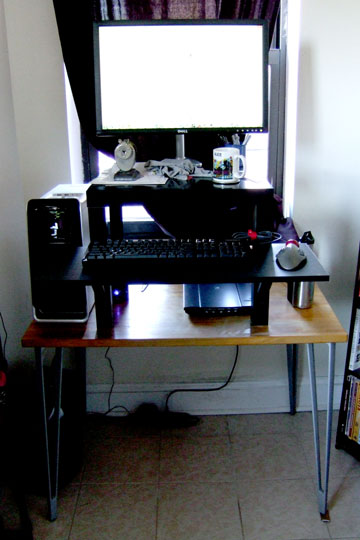
It’s tough to see without me for scale (and with the monitor and sunny window blowing the contrast) but I used this cheap Ikea-hacked solution (<$30) which rests atop my previous Ikea Frankendesk.

I’m looking into a gel mat to soften the tile floor a bit but currently I’m just wearing running shoes.

So far I’ve listed a box of books and here I am writing a blog post so it seems like standing is working out so far.

This actually brings me back to my early bookselling days when I stood all day–sporting a name tag and worn out khakis–and fetched gift books for the barely literate. That has mixed appeal obviously but I choose to focus on the memory of being limber, relatively skinny and in my early 20s.

I’m not going to lie, I am 100% looking forward to sitting down with a movie over lunch but the contrast will add some zing to my day.

And because I can’t let anything stay healthy and productive for long, my next project is to pick up a PC arcade stick and turn my desk into a Sinistar emulator.
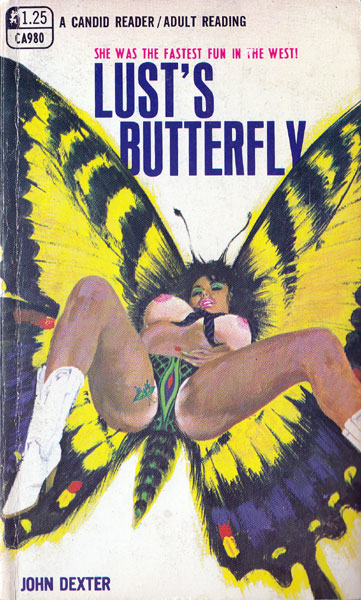
Lust’s Butterfly

Author: John Dexter
Year: 1969
“She was the fastest fun in the west! It began, for Bob, with a dogfight in the sky, and ended up with carnal combat in the bushes with three round-heeled beauties”

Two of My Favorite Things

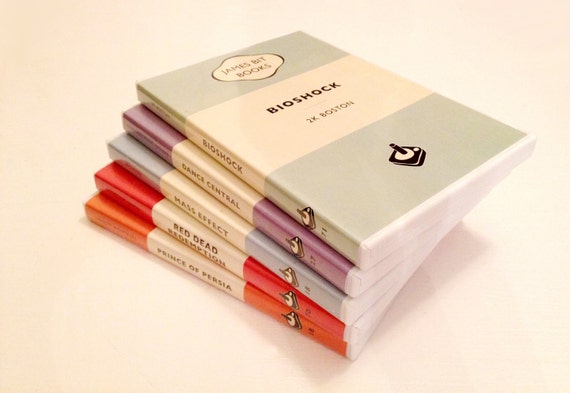
Etsy craftsman James Bit offers custom jackets for videogames that can make your copy of Dead Or Alive Xtreme 2 look like a classy vintage Penguin paperback.

He also offers cool 8-Bit inspired floor decals that can put a Zelda-style hidden staircase underneath your library chair.

Link via The Double-Breasted Dust Jacket.

These–together with A.J. Hately’s work that I blogged previously–give me hope that game and digital media addicts won’t forget the aesthetic and tactile appeal of a well-designed book.

Customer Wall: Stephen R. Bissette

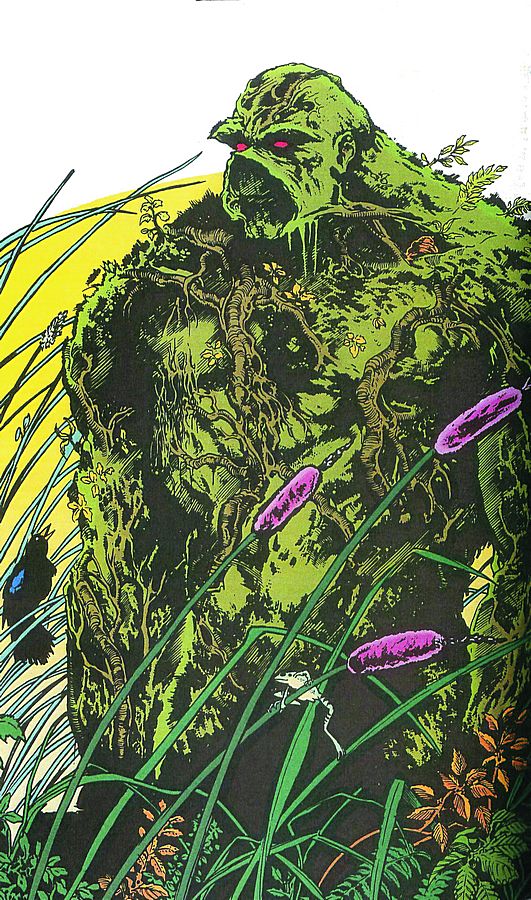
A few days ago I was excited to wake up a to a book order from a Stephen R. Bissette! A bit of cyber-stalking and a fanboyish email confirmed that this was the same Stephen R. Bissette who drew the classic Alan Moore run on Swamp Thing;

and published the ground-breaking horror anthology Taboo!

My favorite project of Bissette’s was Tyrant, which was conceived as the birth to death biography of a tyrannosaurus rex drawn in drippingly, gruesome Cretaceous-era detail.

Sadly Tyrant only ran for four regular issues but Bissette occasionally returns to the character and he offers an excellent print on his website which introduces his baby tyrannosaurus to Winsor McKay’s Little Nemo in Slumberland.

Pick one up for the dinosaur or comics fan on your Christmas list.

God Of Blades

God of Blades is an IOS hack and slash by White Whale Games with a beautiful art style, pounding prog-inspired musical score and an epic fantasy pedigree that includes Michael Moorcock, M.R. James and Roger Dean!
Check out the bookish trailer above and admire the inspired promotion lets you unlock special weapons if you FourSquare check in at a local library.
I don’t have an iDevice bitching enough to play this at the moment but as soon as it comes to PC I’m all over it.
Link via Venus Patrol.

Curious Book Reports: The Magic Scalpel

The surface of his life was as clean and shining as new skin…Underneath however, the past opened to throb in his memory, an ugly unhealed scar…

This paperback original by plastic surgeon and self-help guru, Maxwell Maltz caught my attention because of my fascination with gruesome scenes of surgery in books and film. Thomas Pynchon’s nose job in V., and the botched club foot correction in Flaubert’s Madame Bovary are two of my favorites. And the post-WWI photo-documentary Plastic Surgery of the Face by Harold D. Gillies is now horrifyingly accessible on my Kindle.

Robert Graham, the main character in Magic Scalpel, is described in the Mary Sueish mode as a “rugged” plastic surgeon who looks like a “nice young, pleasant prizefighter.” He has a highly successful practice and lives in a luxurious penthouse above his surgical domain. The 1960 portrait of opulence and the will-he-or-won’t-he marriage plot are fairly insipid but the book’s surgical detail is vivid and authentic sounding.

In the early pages of the book, Graham corrects a six-year-old’s hare-lip:

It gaped at him, the rough edges curling back like a second vertical mouth….[His] blade dipped down, paring away muscle from the skin above the mouth and the mucous membrane inside.

and removes a concentration camp tattoo from a Holocaust survivor (only to present her with the marked skin preserved in alcohol).

You can see the author’s body image-based self-improvement streak (that gave rise to his Cronenbergian sounding bestseller Psycho-Cybernetics) in the way the touch of a surgeon’s knife places all the secondary characters on a better life path. Also in the way he draws revealing lines between “the beautiful and the almost beautiful, the ugly and the grotesque and saddest of all, the dull-as-dish-water plain.”

The novel–though it barely moves for most of its brief 160 pages and ends on an odd note with the genius surgeon deprecating his specialty in favor of pure research science–establishes an interesting and surreal contrast between the dated melodramatic tone and the vivid and realistic surgical scenes.

If interested you can buy my copy here.