Classic Games as Classic Paperbacks

U.K. artist A.J. Hately has been designing covers for alternate video game manuals inspired by classic British paperbacks. It’s a stunning series. Here are a few from some of my favorite games:

Katamari Damacy:


Super Mario Land


Shadow of the Colossus


The series continues on her Tumblr site, Wilderness as a Girl, and she has prints available.

I love that most of the books take their titles from literary-sounding game locations, characters or lines (and that the Katamari book has an intro by Myth of Sisyphus author Albert Camus).

Going to keep an eye on the series and spend some time picking out a print or two.

Link via Joystiq.

Paperback Review: The King in Yellow

So it’s been a long, long time since I last checked in. Between malaise, time consuming freelance gigs, and attention drift to lower maintenance social media (and subsequent exhaustion with those), I’ve barely been able to moderate the comment spam without being paralyzed by guilt.

My schedule has opened up though and–now that I have something to link promote with my spanky new ecommerce site: hangfirebooks.com–it’s time to dip the toes back in.

I’m going to start slow and just try to read and review one vintage paperback every one to two weeks.

My first:

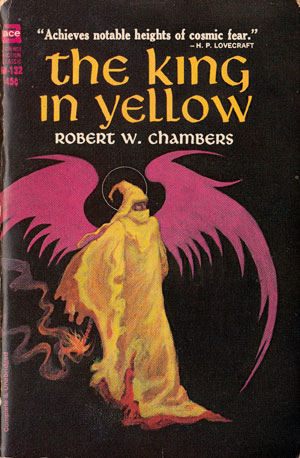
The King in Yellow


The King in Yellow is a collection of short fiction published in 1895 by Brooklyn-born writer, Robert W. Chambers. The first four stories (“The Repairer of Reputations”, “The Mask”, “In the Court of the Dragon”, and “The Yellow Sign”) are linked by the recurring appearance of a notorious, suppressed play entitled “The King in Yellow,” the second act of which will drive an impressionable reader insane.

This fictional work plays a varying role in each of the four stories. In “The Repairer of Reputations,” the narrator–after a brain-scrambling fall from a horse–works with a mutilated dwarf to bring about the Imperial Dynasty in America and the reign of the King in Yellow. In a later story, the book merely sits on a shelf and is noticed with a shudder. Each successive mention of the book adds to a sinister alternate history that forms the backdrop to this collection.

Robert W. Chambers, a bestselling author in his time, is today remembered primarily for his influence on H.P. Lovecraft. Lovecraft discussed Chambers in his Supernatural Horror in Literature, paid tribute to Chamber’s use of the book within a book with his Necronomicon, and directly integrated The King in Yellow–and his lost cities of Hastur and Carcosa–into the Cthulhu mythos.

Chambers’ influence also seems clear in the work of Daphne Du Maurier, particularly “Don’t Look Now” and her time travel romance The House on the Strand.

Chambers’ style, in the four linked stories, is vivid and evocative. His writing feels less dated than Lovecraft’s though the stories do have somewhat trite and predictable outcomes (or perhaps they have since become horror cliches). I keep emphasizing the first four stories because the remaining tales in the collection have no real connection to The King in Yellow. Two stories–“The Demoiselle D’Ys,” and “The Street of Four Winds” are passable supernatural tales but with excessively romantic endings. The remainder I struggled with, finally flipping ahead to see if they became interesting but that didn’t seem to be the case.

Reading this left me with several questions that Google and Wikipedia don’t want to answer. Maybe there’s a Chambers aficionado out there who can help me out?

1.) Was this originally published in book form? I see the 1895 first edition but I don’t see any reference to earlier serial publication. It seems a very peculiar structure for a work conceived as a book. I did find one web reference to the non-KIY related stories being being added later but it wasn’t sourced.

2.) Was this book a bestseller? I know a number Chambers’ later romances became bestsellers but not sure about KIY.

3.) Are there earlier occurences of books within books that are haunted or drive the reader insane? The only thing that comes to mind is Don Quixote but it took a whole library of books on chivalry to drive him mad (and most of the name-checked titles were real). I feel like there must be something in Kaidan Japanese ghost stories at least.

4.) Lastly, where did Chambers live in Brooklyn? I always like to check out dead author haunts.

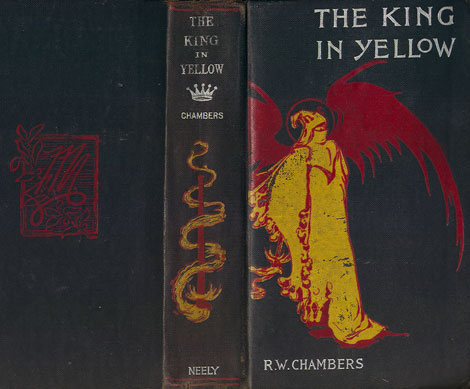
The edition I read was an Ace paperback (M-132) from 1965 with a cover painting by Jack Gaughan (based on Chamber’s own design for the first edition).


Photo Catch-up

In my state of blogging lethargy, I’ve accumulated a number of miscellaneous photos that haven’t found a post of their own. Here’s a big photo-dump to bring myself up to date.

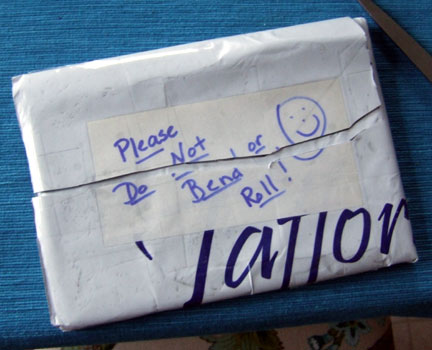
One for my Book CSI series analysing book abuse, neglect…and here just ineffectual good intentions:

This message was jotted–with the enthusiasm of a 10-year-old girl–on the outside of a package that was folded in half in my mail box. You can’t rile a postman like that. In the time it took to write this cutesy and pathetic plea, the seller could have cut a piece of cardboard and reinforced the book so that it would actually be inconvenient to pound it into taco shape.

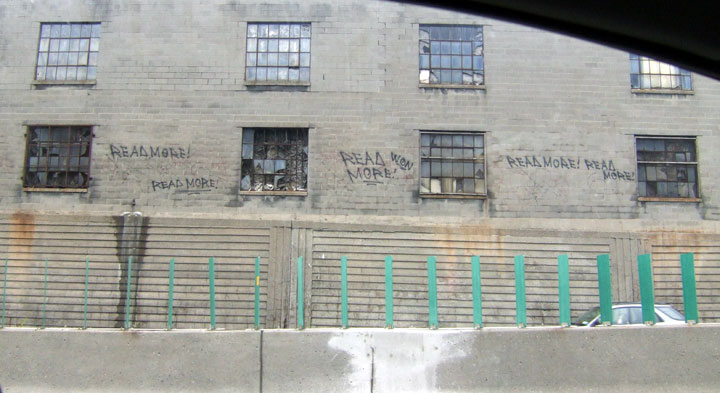
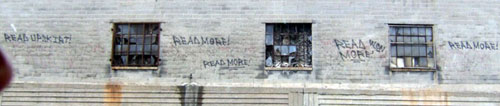
Here’s one of my favorite grafitti tags (after “Neckface” and “Backfat”) that appeared near my subway stop on the Q train:


An edifying message, diluted a bit by the appearance of the classic “upsk*rt”, but still I’d like to see this one go city-wide. Really curious what kind of crap this building is stuffed with. Didn’t notice the mountain of clutter until I processed the photo.

My folk art, big rig toy chest in its new home:

That’s Mego Spock riding shotgun, with Scotty at the wheel. I found this at a stoop sale back in June and I couldn’t part with it. I think I’ll use the trailer as my time capsule for stashing hi-grade books that’ll be rare in 10 years.

Jug City:

We pass this establishment every year on the way to camp. I love a “Postal Outlet” with signage like an off-brand Hooters. Last time I saw Jug City, some other–relatively jugless–business had taken over the space but thankfully they kept the name. One day I hope to retire to Canada and open “Jug City Books” and the window display at least will be up to snuff.

…keeping to the theme. My favorite bad break (one of the quiet joys of proofreading) in recent memory:

Amazon suggested this “pay phrase” to my demure wife (“…embly” was after the break). She passed on that one for some reason. Previous to this my favorite BB I discovered in a book catalog I was proofing was:

The most feared weapon in Hitler’s arse-
nal

And lastly a haul from a month or so back that I forgot to post:

All from the GOB sale of an estate/storage liquidator. My best one-time cartridge score until the World’s Largest Garage Sale earlier this month. This photo is part of the “Junk in Your Trunk” photoset on Flickr documenting garage sale and thrift finds.

All right, caught up. And until I replace my scanner the Hang Fire Blog will likely be a bit image light. So does anyone have any particular aspect of bookselling, pulp fiction (or whatever) they’d like to see me write on? The brain is a bit scattered lately and I wouldn’t mind some outside imposed direction.

World’s Largest Garage Sale Haul, 2010

.flickr-photo { border: solid 2px #000000; }.flickr-yourcomment { }.flickr-frame { text-align: left; padding: 3px; }.flickr-caption { font-size: 0.8em; margin-top: 0px; }

My epic haul from the annual World’s Largest Garage Sale in Warrensburgh, NY. Not a bad last hurrah for the 2010 garage sale season.

Favorite moment from the sale: Receiving a text message from the wife saying “This booth has Sega games AND machetes.”

As usual you can see this photo with notes/annotations in the Junk in Your Trunk pool on Flickr.

Maker Faire

I’ve found that I’m fairly terrible at event coverage so here’s a simple list of the cool things I caught at the New York Maker Faire hosted this past weekend at the New York Hall of Science.

FRC: First Robotics Competition
High school students participating in the FRC (“A varsity sport for the mind”) showed off robots from the recent 2010 challenge, which was to build a soccer-playing robot. These students were among the most excited and outgoing presenters at the fair and managed to pull off the–inconceivable in my generation–coup of being in high school, a science geek and cool simultaneously. There will be a scrimmage this Saturday (October 2nd) at the Francis Lewis High School in Queens. Check it out if you’re in the NYC area.

Frank DeFreitas of Holoworld demonstrated his approx $100 DIY garage kit for creating holograms; using a laser pointer, metal pipe, some bulldog clips, and a lens. Frank has been creating holograms and teaching the process since 1983. His website has details on his workshops and updates on new developments in the art.

Mustafa Bagdatli explained his high tech, interactive mood ring project called “Poker Face” which uses “a heart rate monitor and galvanic skin response” to provide real time and highly visible readings of a user’s emotional state (mood changes are displayed via a color changing medallion). The coolest feature of this project to me was the ability to sync this data with something like Google calender so you can track exactly who/what makes you happy and edit your life accordingly. It also made me imagine the potentially amusing conversations with spouses when they ask something like “Why were you so happy between 1:30 and 1:35 last Tuesday afternoon?”

Well above my understanding level, but incredibly cool is the Orbotix hardware/software platform for turning your mobile phone into a remote control unit to command killer robots.

Proteus Gowanus (543 Union Street in Brooklyn) hosts a “Fixers’ Collective” every Thursday night. A “social experiment in improvisational fixing and mending”, participants bring in broken objects and the accumulated expertise and brain power of the room tries to diagnose and fix them. Looking forward to attending a few of these this winter. Unfortunately most of my broken electronics were sent off to the “Deconstruction Lab” organized by my lovely wife for one of NYHOS’s own Maker Faire workshops. Guess I will have to break more things.

Lastly a mesmerizing kinetic sculpture by Brad Litwin:

The piece shown at the fair was even more complex than this as the entire sculpture spun and the balls were catapulted through small holes in two spinning sheets of plexiglass. I could have stared at this thing for days.

Also noteworthy the 3D printer pavilion, life-size Mousetrap, the Rubiks solving robot, and lots more.

All-in-all a great time. Check it out if it comes to your town.

Testimonial

Jim Linderman posted a fine testimonial to my store over on his Vintage Sleaze Blog:

He is a “value-added” bookseller…that is, he knows his material and he willingly shares the information. If a book like one of those above was written by a hungry REAL writer with a pseudonym, he’ll tell you who he was. If a title affects him in a particular way, he will take the time while cataloging it for sale to tell you why.

William leans towards the unusual and curious, as any serious book hound should. His prices are low. His service is high. He will reasonably repair and restore your rare paperbacks…He has a fabulous set of links. He is honest and entertaining and his website/blog/bookstore is the same.

[Blushing] I must cop to the fact that I’m not as nice or as helpful as Jim describes but this at least gives me something to shoot for.

We may get stuck in a Mexican standoff of mutual appreciation but Mr. Linderman is an outstanding image-archaeologist who has compiled a shelf-ful of worthy and unique photographic histories. A few highlights:

Camera Club Girls captures the–somewhat–innocent early days of private pinup photography through the work of one artist who meticulously and beautifully hand-tinted his photos.

In Situ: American Folk Art in Place presents a beautiful collection of outsider art and roadside attractions mostly through the vanished medium of the real photo postcard.

And his Vintage Sleaze Blog regularly presents art and ephemera that is totally new to me and gets me salivating with acquisitiveness. Witness this Charles Mingus 7″ with art by sleaze grandmaster Gene Bilbrew from his most recent post:

You can find a catalog of his book and blog projects here.

Thanks for the shoutout Jim!

Bionic Books

A friend sent me a link to a French publisher with an interesting mission statement:

Les editions volumiques is a publishing house focusing on the paper book as a new computer platform, as well as a research lab on book, (computational) paper, reading and their relation to new technologies….

…video game interactivity sheds a new light [on] the potential of a story [and] the role of the reader…. We do not consider the e-book as the replacement of the paper book, but we wish to enrich the tangible…connection that paper brings with all the new dimensions of the digital world. Each of our projects explores a different face of this union of paper and computation.

Their flash-heavy site (with non-embeddable videos unfortunately) showcases some stunning and fascinating projects.

Several use the iphone’s camera and touch sensitive screen to interact with game boards and artfully designed branching books. My favorite of this type “The Night of the Living Dead Pixels” is a multi-directional fold-out book imprinted with treated stills from NOTLD. The iphone camera picks up bar codes (that are cleverly blended into the high contrast b+w images) which trigger specific video clips on the iphone screen; transforming the book into a multiple-choice role-playing experience.

Another project is:

“A prototype of a paper video game using reative inks to makes shapes appear and disappear dynamically on the paper. A tiny joypad allows to play [sic] with the duck to open the door to the next page.”

The video shows what appears to be a page torn from a children’s book crazily trailing wires like witch’s hair. A hand controls the movements of a small duck through an abstract city-scape. If this ever becomes practical/affordable it could be beautifully implemented in picture books (or pop-up books! Imagine a pop-up book made with this “reactive paper”).

I really like the way this studio is going with their re-imagining of the book form. They’re innovative, exciting and–perhaps best of all–unlike traditional ebooks they’re collectible and resellable!

See all of their projects here.

Summer Book Report

People who’ve stuck around for a while know that a large percentage of my pleasure reading happens during a regular summer vacation in Canada’s Algonquin Park. This year was no exception, but I left the title selection more open-ended since we were bringing up four boxes of books for the cabin library.

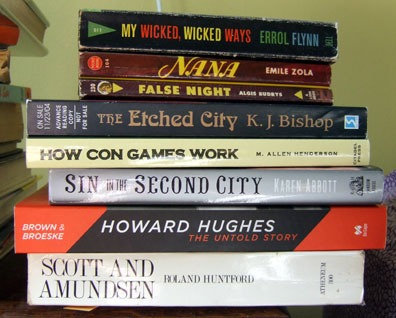
From my preliminary pile–displayed last post–I dropped The Etched City (liked the Leone-esque epic fantasy setting, but the dialog was unnatural and irritating), How Con Games Work (a reissue of a title from the 80s that would have been goofy and anachronistic even then), and Howard Hughes: The Untold Story (I enjoy Hughes appearances in Hollywood bios but he may be too much of a gothic loony to read his entire life story even if well-told, which here it isn’t).

Here’s what I did read:

Sin in the Second City by Karen Abbott – A history of prostitution in Chicago at the beginning of the 20th-century, structured around the rise and fall of the “Everleigh Club”. Founded by two sisters from Virginia, the Everleigh was the most comfortable and ostentatious pleasure house in the country. A night at the club could set you back 20-30 times an average week’s wages, but they offered gourmet meals, perfume fountains, three orchestras, fine champagne, and–of course–beautiful (and willing) women from around the world. The sisters had no trouble attracting a high grade of employee as they paid well, treated the women fairly and provided regular medical exams. Chicago’s other madams didn’t appreciate the competition and the resulting scandals, publicity stunts and industrial (?) espionage gave the anti-vice movement a very broad target.

Sin the Second City uses the history of this legendary club to provide structure to a fantastic collection of characters and stories in which the Everleigh sisters–like the best party hosts–often fade into the background. I marked a number of facts and passages in the book that I wanted to highlight but handed it off before I wrote them down. One useful bit of trivia is that the phrase “to get layed” was likely a shortened version of “Everleighed” (which in itself was a play on the hot Old Testament action: “to lie with”).

False Night by Algis Budrys – One of the early Lion paperback originals from a writer/editor I worked with at Tor books. I picked this one because it opens with a lone survivor waking up in a taxi on 14th street in a post-apocalyptic NYC. He works his way across town, dodging sniper fire, and eventually barricades himself–with a female survivor–in a Stuyvesant Town apartment.

The first section of the book–the pacification of Manhattan and beginnings of territorial expansion–are vivid and realistic, but the latter sections suffer from the cramming in of three generations, a didactic theory of geopolitics and a science fictional retelling of The Decline and Fall of the Roman Empire into the typical 130 pages of a Lion paperback. The book was apparently heavily abridged by the editor and was reissued in a significantly longer form as Some Will Not Die. This expanded edition is probably the way to read it.

If He Hollers, Let Him Go by Chester Himes – Set in a shipyard in WWII-era Los Angeles, the main character, Bob Jones, is an African-American crew supervisor. He knows his job well but he also knows that he never would’ve been allowed in the union or promoted if most of the qualified white men weren’t overseas. He’s walking on a wire, but still he can’t help relishing the money and respect he’s receiving for the first time in his life. His steady girlfriend is the light-skinned daughter of a wealthy African-American lawyer. She wants Bob to improve himself so they can be married, but she has a second life away from him when she’s able to pass as white. Aan waiting to drag Bob down is a femme fatale in the form of a hick, racist Rosie the Riveter.

Himes writes with the most well-earned hard-boiled voice I’ve ever read. The story hits all the noir buttons but without any unnecessary or overcomplicated mystery claptrap. My first Himes but definitely not my last.

My Wicked, Wicked Ways
by Errol Flynn – Greatest biography title ever. By the time Flynn wrote this, his on-screen persona and his–admittedly event-filled–life had bled inextricably together like the hues in a worn-out Technicolor print. The stories of his early days–sharpened and improved by infinite retellings–are told with zest and vigor, the latter years with a sad, boozy directionlessness that he’s all to ready to admit. I wanted to like this more but in the recounting of his impressive list of conquests with native princesses, starlets, and coat check girls the only personality Flynn manages to put across is his own.

Asterios Polyp by David Mazzucchelli – An epic and artistically ambitious graphic novel about a celebrated modernist architect who’s fallen into academia without any of his designs ever actually being built. At the beginning of the story Asterios lies in a trashed apartment and appears to be reviewing a tape of a sexual conquest (dated shelves of VHS tapes line his walls). When a fire begins to engulf his building, he runs out taking only three very specific items. The rest of the work is a series of elaborate flashbacks, self-deceptions, and parallel lives explaining how Asterios hit bottom, the importance of each of the things he saved from the fire, and how he might pull himself back up.

Mazzucchelli’s art and writing are accomplished and playful. In a flashback scene at a university cocktail party each character is drawn in a style/color reflecting their academic discipline and personality. This stylistic bubble surrounds everyone, is stronger for the bigger personalities, and only begins to blend when Asterios makes a connection with the woman who will become his wife (later when his marriage is breaking down the styles slowly split apart again). All of this without kicking the reader out of the narrative or feeling pretentious. This scene made me think of James Joyce and the frequently impenetrable scholarship and trickery needed to get an idea like this across in prose. Elsewhere in the book Mazzucchelli describes his main character as an “architect on paper” and a composer describes musical notation as “marks that measure out the passage of time” (? book needed for quote). Better descriptions of the cartoonist’s art I have never seen.

Alright running out of steam. I think I finished one other book but I waited too long and forgot what it was. Still working on Nana and Scott and Amundsen by Roland Huntford.

Parenting Aid and Summer Reading List

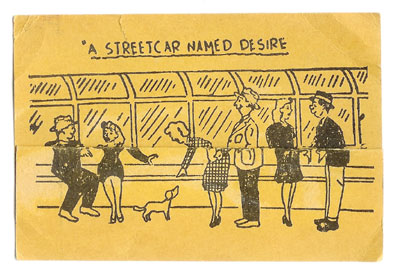
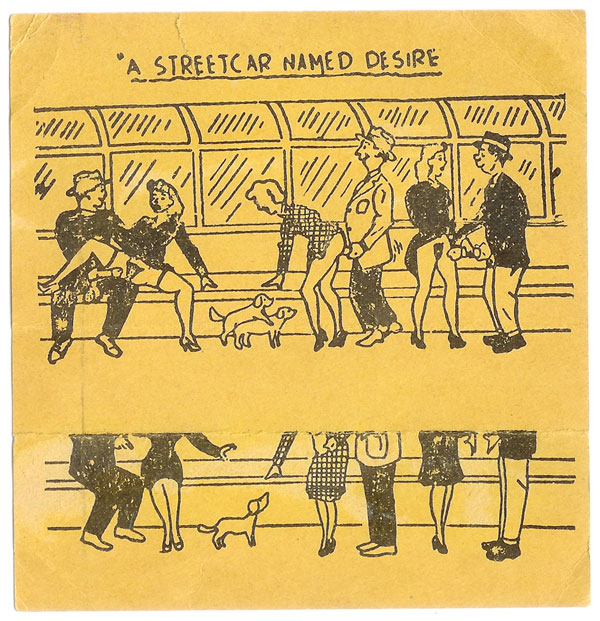
Received this semi-threatening Sunday-school prop as a gimme with a lot of mixed ephemera.

Distributed by First Federal Savings and Loan Association of Peoria, Ill (mid 50s-early 60s I’d guess), it shows two angelic/obedient children over the text “Silent Worship”.

(click on image for larger version)

I think even secular parents might want to print this one out and give it a try (though they may want to paste the image on–ahem–heavier stock).

And before I run out for a desperately needed vacation, here’s my reading pile for the holiday:

Not totally finalized yet. I imagine either the Hughes, the Flynn bio (or both) will prove indigestable but we’re traveling with three cartons of books (staples like Graham Greene, AC Doyle, and Agatha Christie) to upgrade and supplement the cabin library, so I’ll have a lot to fall back on.

Enjoy the dog day folks.