Buying Book Inventory: Striking the Right Balance

Due to drastically slowing sales volume–leading to nervous tic refreshing of my inbox and blank staring at the internets wondering “Is this thing on?”–I’ve been rethinking my buying strategies recently.

Back when the world wasn’t like this, I could count on Amazon and eBay as income pillars and the five others venues I list on as light gravy with the occasional surprise. My buying was divided about 60-40 between eBay / estate sale finds (slower selling but more interesting and financially rewarding) and thrift store hunting (ISBN checked quick-selling utility titles). I bought until I felt like stopping–based mostly on gut.

This is no longer working. My Amazon sales are down to the equivalent of an entry level job in a no future industry and–because of exhaustion and disgust at the high maintenance and ever changing conditions at eBay–my storefront has been nearly empty.

Starting NOW I’m going to much more strategically look at how I buy (a bookdealer is like a shark…you can’t stop buying or you die) and try to more effectively sell what I have. I’m going to total my monthly fixed expenses, see what’s left over and allocate that mostly to–hopefully–quick-selling stock.

I can’t ignore eBay because so many people are unloading good books at desperation prices but the at least 3-week delay between sending a paypal payment for an auction won and the day you can relist that item has become a barrier. I need to focus on only the most promising lots and bid at 15-20% of my presumed resale price rather than my usual 25-35%.

Sales-wise, I’m starting to repopulate my eBay store focusing on speciality areas in a way that will hopefully attract multi-book buyers. I’m uploading vintage paperbacks in select batches of collector friendly authors and genres. I’ve included an explicit and straight forward shipping chart that should encourage bundling (especially for international sales). And as always I’m auctioning crack lots of common and low-grade titles in the hope that buyers will come back for the heavy stuff when they see the care and attention I give my product.

I’m also digging out those ‘reseach’ items that are stuffed in drawers and getting them listed (since they’re long paid for) and opportunistically buying up cheap non-book items (toys, games, wacky crap) that I’ll quickly turnaround and–again…hopefully–pay for the slower selling books I pick up.

So, that’s all I got. As a bookdealer how are you wading through the quicksand?

METAPHORICAL LESSON LEARNED: A bookdealer is like a dying–yet hopeful–shark in quicksand.

But seriously people. Support your favorite bookdealer (even if it’s not me). It’s cheaper than a bank bail-out, war, or health care and you’ll have a new BFF.
Book CSI: Dumbass Killfile

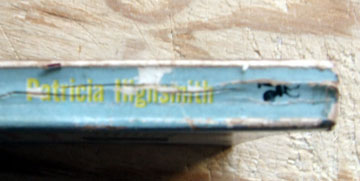
I recently listed a first paperback edition of Patricia Highsmith’s Strangers on a Train and–in the process of pricing my copy–I noticed one on ABE that was underpriced and restorable so I bought it up.

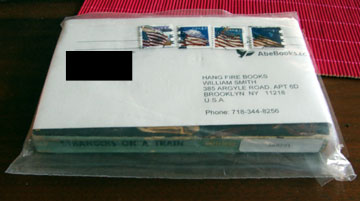
This is what I received in the mail:


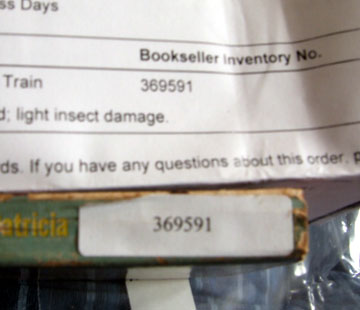
Transparent plastic baggy, no padding or stiffeners whatsoever and–if that wasn’t bad enough– the bookseller had stuck an inventory label directly on the spine of a delicate 58-year-old paperback.


After a careful 10-minute application of sticker removal the best I could do was this…


I recovered and readherred the chip, but what a pain in the ass.

It’s true that I was deliberately buying a low-grade book from someone who doesn’t know how to catalog or price a book but do they have to suck at their trade so badly that they damage books more than they already are (and more than is described in their listing)?

I was so livid that I ended up spending 45-minutes restoring a maybe $25 dollar book.

As of now I’m officially starting my dumbass killfile of booksellers that I will never buy from again. Does anyone have such a list going already? Want to share info?

Studying Filth


I picked up three “Tijuana Bibles” (8-page erotic comics from the 1930s-1950s) at a flea market recently and I thought my process of researching them was worth documenting.

Tijuana Bibles were illegal to sell in most states, there’s no publication information or artist signatures in the booklets, and they were widely pirated and reprinted. So dating them is a bit of an art form.

TBs were distributed more like drugs than like paperbacks. To buy them you had to know a guy who had a connection. We he needed a restock, he had to contact his source and usually drive to pick up new stock personally (since sending “obscene” materials through the mails and across state lines was–and sometimes IS–a serious offense). The source usually had one or two in-house artists who drew the material (generally parodies of movie stars, comic characters or headline makers) or else would shamelessly reprint TBs acquired from another source.

Knowing this I looked at my three newly acquired TBs. All are bound in the same manner–a one-piece folded cover with a single staple in the middle; are on similar paper stock; and show the same level of age toning, so they’re all likely from the same source/publisher from around the same time. They’re also likely first printings or from the original art. I determined this by the vivid, high contrast reproduction. Later printings can appear faded or difficult to read because of detail loss (which has sometimes been filled-in or redrawn by a second, less-skilled hand).

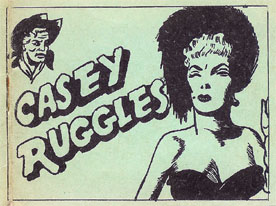
Two of the bibles are generic gags and feature unrecognizable characters but the third is a parody of the Casey Ruggles strip by Warren Tufts with started in 1949 and ran until 1955. So we can safely put the bibles somewhere in the 1950-52 range (TB publishers were quick to find new material to parody so I’m putting these in the early years of the Casey Ruggles strip’s run). Were the Ruggles bible not part of the lot, I might attempt to date these by the gag contents…or the folk popularity of French hair dressers and cunnilingus, but that would be trickier.

Lastly I believe all of the bibles were drawn by the same unknown artist. This is due to the identical cross-hatching/shading technique in each of the bibles, the similarity of the figures and the joke contents (which all seem fairly progressive for the medium–showing a woman coming out on top–and are actually funny and well-told).

Here are the bibles in question (NOT WORK SAFE repeat NOT WORK SAFE): Andrie’s Beauty Shoppee, These High City Prices, Casey Ruggles

…and if you’re seeing this on my Facebook page and happen to be a family member or old grade school teacher DO NOT CLICK ON THESE LINKS (or at least don’t tell me about it).

Friday Linkage

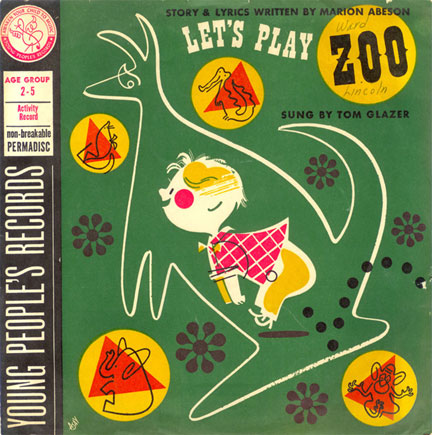
Designer/Blogger Michael Newhouse and the proprietor of Windy Hill Books left comments on one of my old posts about Young People’s Records perhaps identifying the mystery artist of this charming record cover:

Abe Ajay is the often unsigned artist of the majority of the YPR And CRG covers, according to the book Revolutionizing Children’s Records by David Bonner. Bonner has a blog here.

Bonner’s book looks like a fascinating reference on this storied series of records–which recorded talents like Raymond Scott and Groucho Marx–and came under the eye of Joseph McCarthy. Must read more.

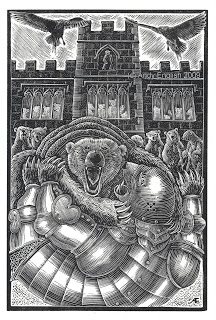
Engraver, bookplate artist and blogger, Andy English shows off his designs for the Oak Tree Press limited edition of Philip Pullman’s A Outrance (“To The Death”) a lost chapter from the Golden Compass series.

Looks like a stunner. Sign up for an email publication notice here.

And collection development blog The Private Library explains why a pile of well-preserved science fiction paperbacks is more bibliographically valuable than “fine press publications, printed on handmade paper using hot metal type, bound in full Niger goatskin or similar materials, with no title having been produced in more than 100 copies”…and therefore more worth collecting and buying.

Seems obvious to me but it’s a good argument.

New York Panorama

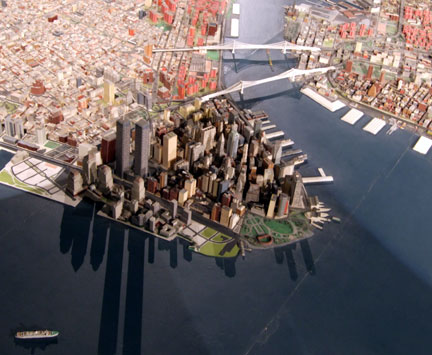
Those of you who listen to New York Public Radio or read the Times probably heard about the cool fund-raising effort by the Queens Museum of Art for the updating and maintenance of the New York Panorama.

If you haven’t, in short you can “purchase” buildings in the massive scale model of New York City that was Built by Robert Moses for the 1964 World’s Fair, a “9,335 square foot architectural model includ[ing] every single building constructed before 1992 in all five boroughs; a total of 895,000 individual structures.”


As soon as I heard this I printed the form (pdf) and bought our apartment (private house/apartments are mostly $50) and last week I went out to survey my property; probably the safest real estate purchase one could make right now.

The model is fairly overwhelming with a cool pseudo helicopter tour, city sound effects and tiny planes taking off from JFK.

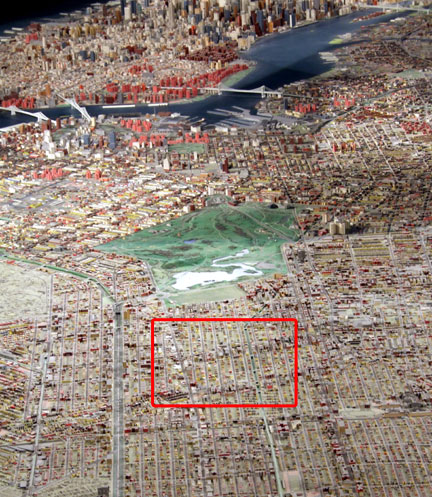
I found my neighborhood after a bit.

Ditmas Park, Brooklyn

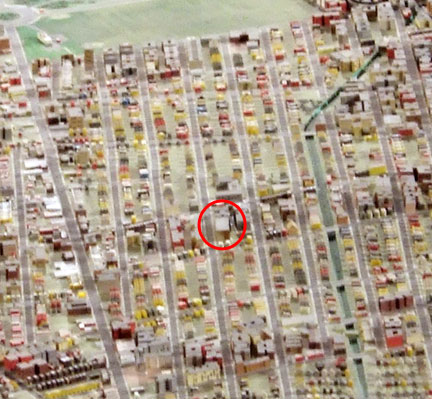
And with the help of Photoshop picked out my building.

Approx 3/4″ tall, 1 1/4″ wide.

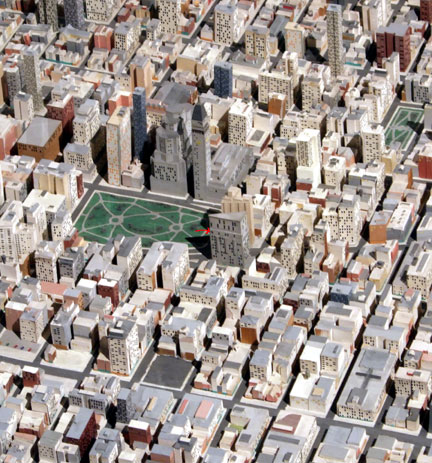
And here’s the Flatiron building where I worked for a few years at Tor Books.

14th floor. My window was on the opposite side of the building.

I wanted to find all my apartments, places of employment and the shitty dive bars I’ve frequented since moving to New York, but I was getting serious eye-strain.

Wishing for street level views on Googlemaps.

Watchmen Embroidery

Crafter Kittyzilla posted these fantastic Watchmen embroidery patterns on the Handmade Stuffs Blog. My two favorites are below with her explanation of the design process. I might have to learn how to embroider just to make a Rorschach.

I think Nite Owl II is my favorite of the bunch. I love the way the frame and background came out and he’s making that “I’m a paunchy nerd who fights crime” face. Plus his quote is stupid and makes me giggle.

I wanted these to sort of look like a cross between a portrait and a religious icon. The religious icon I like not only for the look, but also because there’s a certain mythological aspect to super heroes. Working with that, almost all of them have sort of the suggestion of a halo behind them. Also, I am one of those people who finds Rorschach absolutely adorable. I am properly ashamed of myself, don’t worry.

Link via Kimmchi

Junk in My Trunk: April 4, 2009

.flickr-photo { border: solid 2px #000000; }.flickr-yourcomment { }.flickr-frame { text-align: left; padding: 3px; }.flickr-caption { font-size: 0.8em; margin-top: 0px; }

(click on the photo to go to the flickr page with annotations)

My haul from last weekend. This was the second trip with my estate sale cohort found on Craigslist. The arrangement is still working great and I picked up many things that I would have had no access to otherwise.

My goal is usually to buy some non-book items that I can eBay immediately, make back my investment and then the books (and any items I keep for myself) are gravy. So far this strategy has been working but I am occasionally stuck with an albatross.

Lazy Linkage

Running with a pretty low energy bar lately (If I were playing Gauntlet it would be saying “Warrior needs food…badly”) so here are a few lazy links.

Craig Yoe (author of Clean Cartoonists’ Dirty Drawings, and Modern Arf) has collected rare fetish art from Superman’s co-creator Joe Shuster in a book called Secret Identity. This is the first I’ve heard of this period in his career so this is high up on my wish list. (link via Drawn!)


Parka Blog posted a fascinating photo set of artists’/graphic designers’ work spaces. I always love these peeks into the creative process.


Lastly John Waggoner Jr.–a retired archaeologist for the U.S. Army Corps of Engineers–searches for lost cemeteries and “grave houses”, miniature wooden structures built over graves (early 1800s into the 1900s) that sometimes contained furniture, books, pictures etc. They’re disappearing fast and he’s on a quest to find and document them.

http://media.scrippsnewspapers.com/corp_assets/trinity_inline.swf
(from knoxnews.com, link via bldbblog on twitter)