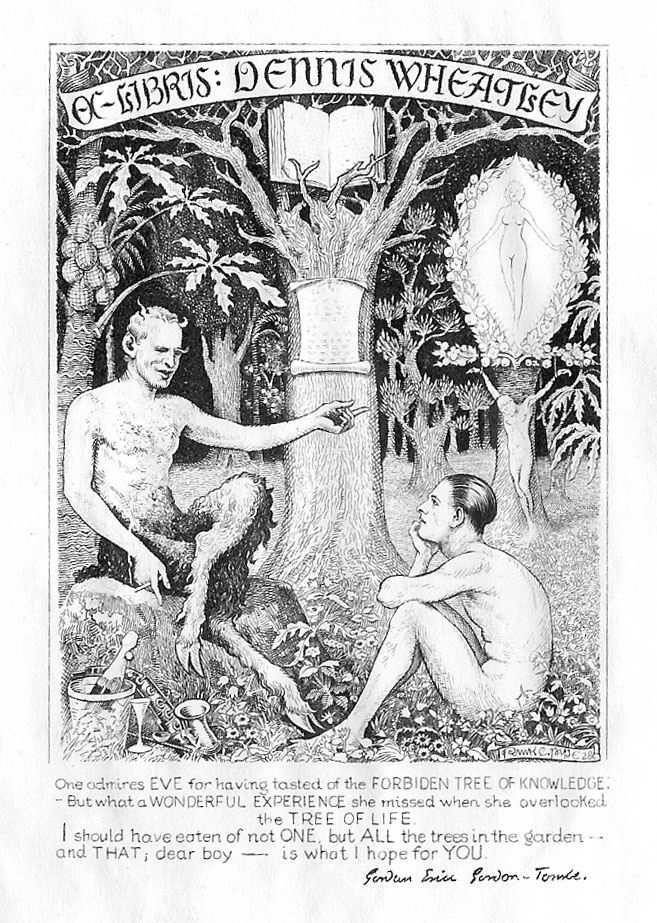
Dennis Wheatley Bookplate by Frank C. Papé


(click for larger version)

I recently learned that one of my favorite illustrators, Frank C. Papé, did a bookplate for British Horror/Occult author Dennis Wheatley.

Papé did illustrations for a series of Bodley Head editions of allegorical fantasy writers; James Branch Cabell and Anatole France. The plates are vivid, bizarre and frequently use a pseudo-3D technique placing parallel action on different focal planes. To me he looks like a precursor of underground cartoonists Robert Williams and S. Clay Wilson.

I tracked the plate down and I’m very pleased with it. A jazz-age satyr smoking a cigarette with an iced bottle of Champers nearby, nudity, suggestive pagan imagery, a sacrilegious coda, all of my favorite things! Definitely one of the gems of my collection.

I haven’t read Wheatley yet, but if his taste in bookplate artists–and the batshit crazy Hammer adaptation from 1968, Lost Continent–are indicators, I expect to enjoy his work.

Nearly 50 New Covers

.flickr-photo { border: solid 2px #000000; }.flickr-yourcomment { }.flickr-frame { text-align: left; padding: 3px; }.flickr-caption { font-size: 0.8em; margin-top: 0px; }

…in the Pulp Fiction Cover Gallery including another rare early Harlan Ellison JD title.

Housing Works Geektacular Sale

So I paid the $50 preview fee and there’s no way I was publicizing this before I had my fill–but this weekend (today, NOW) Housing Works bookstore (Crosby Street, Below Houston, NYC) is having a massive Geektacular sale on Comics, Records and Vintage PBs.

5 for a dollar all you can carry away. I was very happy with the PB section, so much that I never made it to the comics or records.

Definitely worth checking out.

Last Minute Save

Was having a really crap book-scouting day yesterday. I hit 4 thrift stores scattered over 5 miles (walked) and found NOTHING for resale. Best I could do was two books for me–Doctor Bowdler’s Legacy: A History of Expurgated Books and a salty memoir of a pool hustler for the con artist library, McGoorty: The Story of a Billiard Bum.

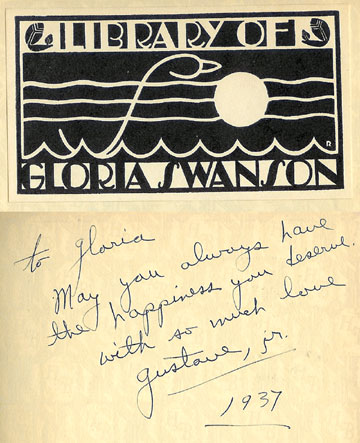
Stopped in a last ditch Salvation Army (that’s normally fruitless and that I looked over just the other day). Saw nothing new but I picked up the ONLY book that might possibly contain a bookplate and found this:


Gloria Swanson’s bookplate with a gift inscription!

My first true celebrity bookplate find. Only dilemma now is keep or sell…

Lest We Regret

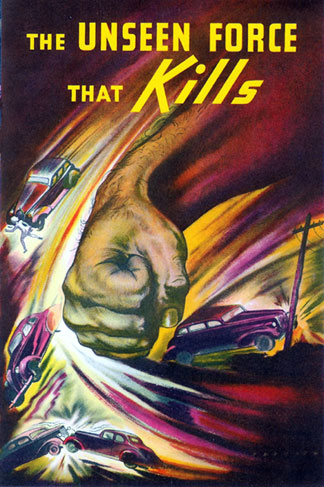
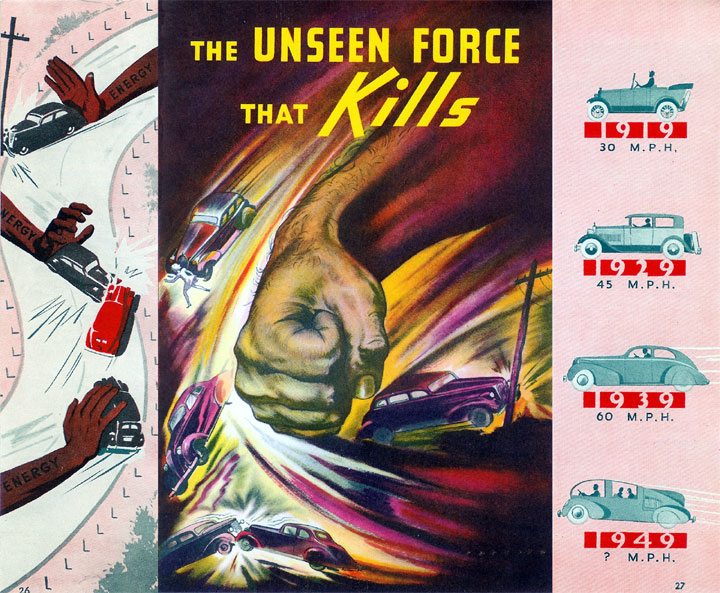
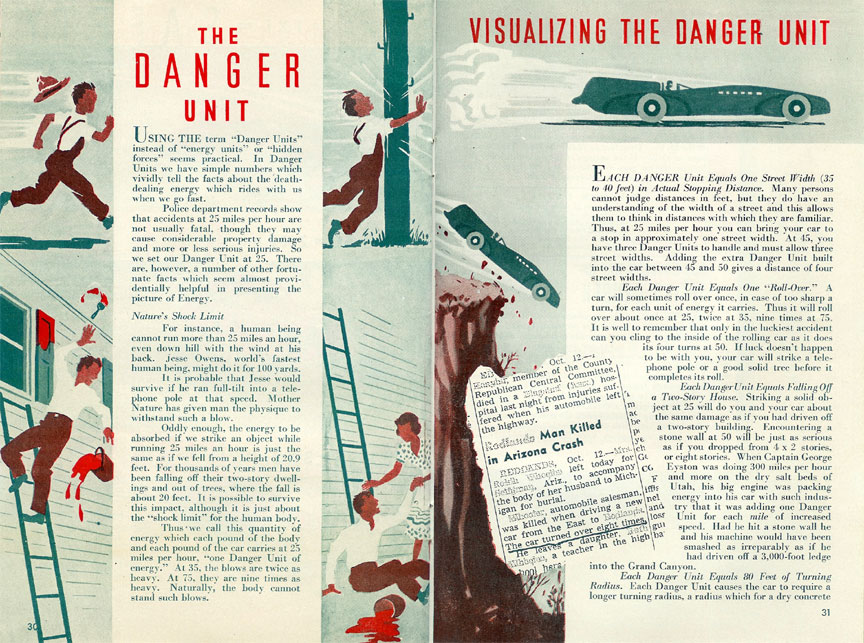
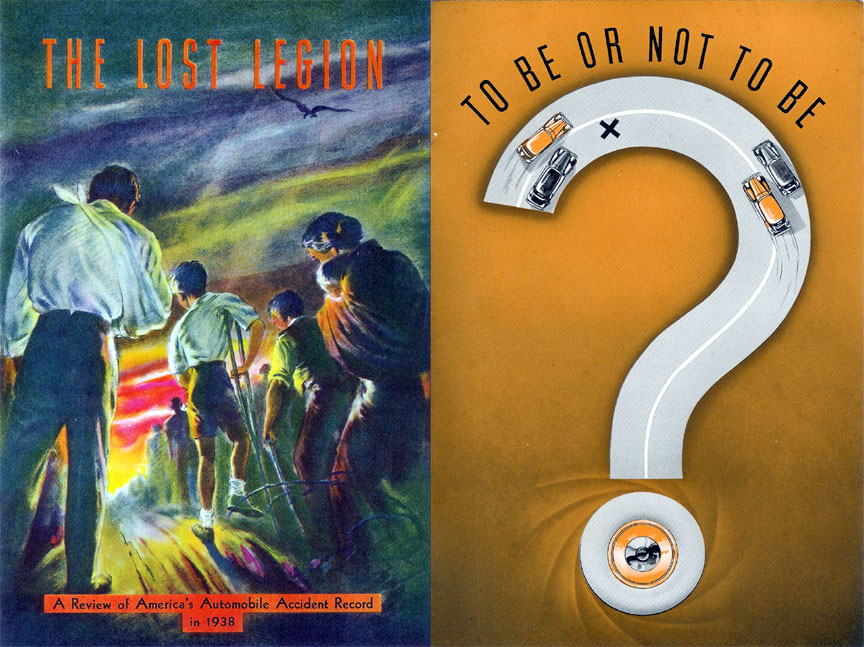
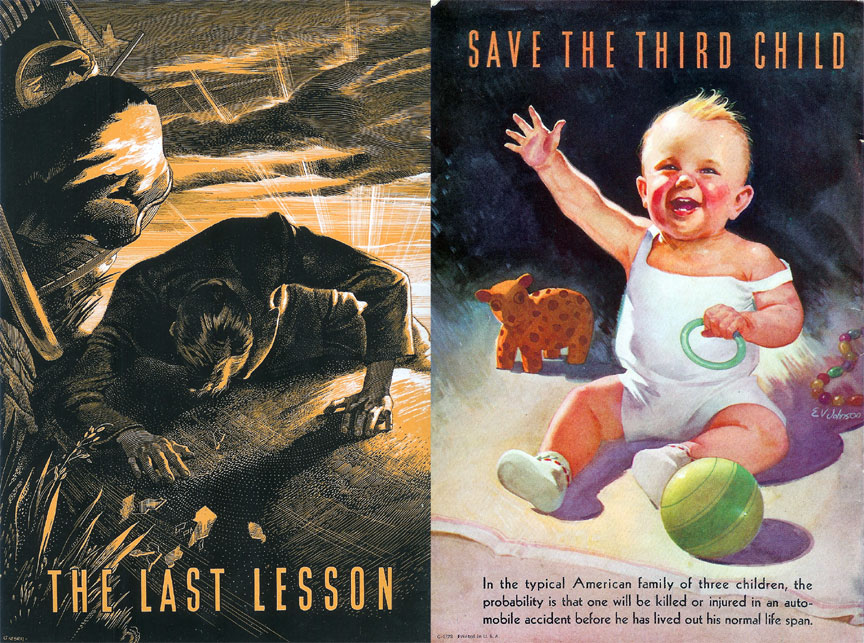
Posted on eBay right now, I have a 1940s educational booklet on the dangers and consequences of unsafe driving published by the Travelers Insurance Company.

It’s filled with beautiful painterly graphics portraying the aftermath of car accidents, plus short fiction, cartoons, charts, statistics and more.

Here are some of my favorite images from the booklet, together with a handy explanation of “The Danger Unit”.

Lest We Regret: 1, 2, 3, 4.

End-of-year Book Post-Mortems

The end-of-year recession round-ups brought a flurry of articles on the current state of bookselling. This one from the NYT was the most grating:

Bargain Hunting For Books and Feeling Sheepish About It

The author laments the Houghton Mifflin buying freeze, folding indies, and faltering chains, but states that we shouldn’t “blame this carnage on the recession or any of the usual suspects” (you know; the real estate bubble, bestseller driven publishing, superstore culture, mushrooming media distractions) but rather on the “networks of amateurs who sell books from their homes” and the people who buy from them.

There’s barely a fact in the article…and sadly I can’t rally the ones I want to counter him. Anybody know the percentage of book buyers who’ve bought a used title online? or the ratio of Amazon’s used versus new sales? Unless some of the other “amateurs” out there had a much better ’08 than me, I can’t imagine the numbers are all that formidable.

The author pays lip service to the fact that “resellers…offer a great service [and] this is a golden age for those in love with old-fashioned printed volumes” but he mostly treats this as fiddling on the deck of the Titanic and doesn’t explore the real game-changing possibilities of an easily accessible second hand market.

For example:

Of the last 10 sales I’ve made, you’d be lucky to find 2 of the titles at even the most well-stocked indy. The rest would have taken weeks/months of searching or (pre-internet) the acquisition of specialized mail order catalogs. In that time there’s a good chance that the buyer would have a) moved on or b) spent the extra cash on something else.

At least 2-3 of those books went to small towns that have probably NEVER had a bookstore, or at least nothing better than a Waldenbooks in the mall (I know these towns exist, I grew up in one).

Another couple went to distant lands (Sweden, Germany), markets that I would have had no access to previously (and believe me, I’ll be spending those Marks and Kroners locally).

Finally the used bookstore where I used to work depended on supplementary internet sales to keep it going (and I’ve heard this from many a brick-and-mortar dealer). Yes it was still staggering and has since died, but it was the doubled rent that killed it. The internet sales were the only things holding back the Verizon stores and the Duane Reades.

The most aggravating thing about the article is the author doesn’t differentiate between the penny/bulk dealers and those who provide a professional service and a satisfying and unique shopping experience. Just because he bought a book for a quarter and it showed up in a floppy bubble envelope doesn’t mean that you can’t do better.

Also the book he describes purchasing for $.25 was in fact between $4-5 bucks with shipping and was bought blind without a real idea of the condition or transit time. A used store could match this price–if the store’s used book buyer is aware of the price point they’re competing with and pays out accordingly–and maybe even mark it up a few bucks for the store ambiance and the chance to pre-inspect your purchase. If the title is too obscure for a brick-and-mortar store to keep in stock then it’s not a sale they would have had anyway and whining about online amateurs is just sour grapes….okay now Im officially rambling.

More links:
The Leonard Lopate Show commenting on the above Times article and the state of bookselling (mostly a love-letter to the Kindle).

A more thought-provoking–and insider–overview of bookselling in the Pittsburgh Post-Gazette, by John Schulman of the Caliban Book Shop (link via The Bibliophile Bullpen)

And lastly a peak inside the 54,000 foot warehouse of online dealer Wonder Books from the Washington Post (link via BookThink News)

Trash Alchemy [One From the Vaults]

Feeling a bit lazy today so I’m re-posting one of my early pieces. This one’s from June 26, 2007 so it will be new to most of you–and I thinks it’s particularly appropriate in this crap economic season. The 3 faithful subscribers I’ve retained since then can move on to the next feed. I’ve updated some of the specifics.

A friend called me Sunday to tip me off about two large boxes of books being curbed nearby. That always gets the juices flowing, so I thought I would post a salvage report describing my technique for squeezing the last dollar from someone’s garbage.

When I got to the books–only minutes after the call–there was already another browser but she was nearly done. I started sorting and putting aside dirt common or truly unsellable books but there weren’t many, so I just sealed up both boxes and brought them home before more vultures started circling (Is there a scavenger that drags the whole carcass back to its den to feast in safety? If so, that’s my spirit animal.).

The majority of the books were recent and in barely used condition so I turned on my bar code scanner and went to work. There were thirty titles that I added to my Bookhound database (to be listed on Amazon, ABE, Alibris, etc). Most were priced in the $4-8 dollar range–which I normally don’t bother with–but they were free. There were a few outliers priced between $50-150 but I can’t say that they will ever sell [2 out of 3 did]. All told, I added about $350 worth of books to my inventory.

Once those were listed, I was left with about 50 “penny” books ($.02-$3 used on Amazon). Some booksellers will list these if they weigh 1 pound or less and try to make at least $.80 on Amazon’s shipping credit, but the stacking and packing would drive me to violence, so I don’t bother. What I will do though is collect common books into interest lots to auction on eBay.

I keep a text file of my lots in progress. Once I’ve added a book’s details, I toss it in my eBay cupboard and forget about it until I have a decent-size list. When the time comes, I insert the new titles into a recycled Turbolister Poster Toaster entry, weigh the books for calculated shipping, take pictures, and upload on Sunday evening. These lots frequently go for my minimum bid (so I set my prices accordingly) but sometimes I get a welcome surprise.

Some lots that I’ve had consistently good luck with are: pulp era paperbacks with suggestive covers; gay/lesbian fiction and non-fiction; single author or series collections; animal books (horses, pigs, mice, etc); New Age/Wicca; westerns, and many more.

[Another outlet I’ve discovered for common titles is PaperbackSwap. When someone requests one of your books, you get a credit to request a book from any other member. I have a wish list of valuable paperbacks a mile long but since they only show up infrequently–and my credits keep increasing–I often request collector’s guides and other hobby books to increase my scouting knowledge. You can also move credits between their sister sites: SwapaCD and SwapaDVD.]

After those two passes, I had about 40 books left that I couldn’t find a “hook” for. At this point I pull out books that are suitable for a used bookstore. Make sure they are in saleable condition and cull the heavily marked, dirty, torn, or out of date titles (the book buyer won’t give you as much $ if you overwhelm them with crap…and if you do it consistently, they’ll remember and eventually ban you). Ask the buyer for credit instead of cash as most stores will give 30%-50% more in credit. If the bookstore doesn’t sell online, scoutpal a few titles. If they do sell online, look for flashpoints they may have overlooked: 1st printings of popular fiction, autographed copies, collectible mass markets, etc. If you can’t find anything to resell, find something you want to read, or better yet find business or reference books for your bookselling library. Always try to spend more than your credit to give them something towards the rent. [Since my original post 3 out of 4 of the nearby used bookstores have gone under, relocated or are in severe financial jeopardy. Support your local booksellers NOW. They frequently order OP titles from sellers like me so it’s a win/win situation.]

When I was done at the used bookstore, I had 15-20 titles left. I walked these down to the Salvation Army/Goodwill, made a donation and got a receipt and write-off come tax time.

Left with an empty cart and box, I went back to Sal’s book rack and started all over.

Best Coney Island Souvenir Ever FREE


A major source of anxiety for real New Yorkers (more so even than economic downturn and dirty bombs) is the impending gutting/condoization of Coney Island.

Current plans for the park include the retention of a few iconic landmarks and rides but for many of them the future is hazy.

Astroland’s Rocketship and Tower have no new home lined up, and if owner Carol Albert doesn’t find a taker before the end of January, they may end up on the scrap pile. Albert is even willing
to pay some moving expenses for the rocket.

So if you need a rocket to launch your offspring to a friendlier star, or you just want to get a SCUD missile trailer and drive it around to freak people out, now is the time to act.

Story and image via The Brooklyn Paper.