
I contributed to a Best Bookseller Moves for 2007 post over at the Bookshop Blog. Check it out and report your own innovations.
Depraved!
.flickr-photo { border: solid 2px #000000; }.flickr-yourcomment { }.flickr-frame { text-align: left; padding: 3px; }.flickr-caption { font-size: 0.8em; margin-top: 0px; }

Depraved (Vanguard V 101) 1966 AUTHOR: Reggie Carr ARTIST: (unknown), originally uploaded by Hang Fire Books.
Arthur Bittner was a seaman, landlocked in a large midwestern city. He had peculiar urges…and he started searching for something to put down the strange impulses of desire…but in the words of a local bookseller this was ‘a tight town; no hot books here.’ And so the vicarious means to settle the blood-lust coursing through Bittner’s body were unavailable. And once the sickness had taken hold, nothing could act as an antidote to Bittner’s sex-crazed, poisoned mind.
See? I provide a valuable service…to depraved landlocked sailors anyway.
Looks like a Bilbrew cover but I’m not 100%.
New stuff in the Pulp Fiction Cover Gallery and a new organizational system. The Sex/Cheesecake set was getting out of control so I broke it down by decade. It’s actually much more illuminating now that all the traveling salesmen, bored suburban housewives, beatniks, JDs, and hippies are sorted into their appropriate time periods.
As always you can subscribe to an RSS feed of my covers here (this is separate from/in addition to the regular blog feed) .

Mystery is next in the queue for a good working over.
Negative Feedback Bookplate
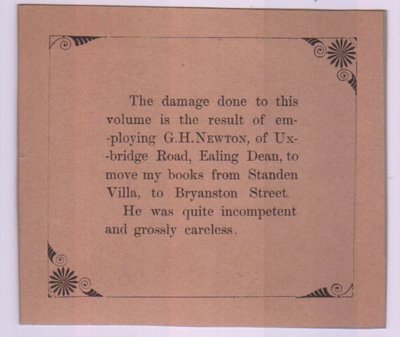
This hilarious, vengeful bookplate was recently posted by Lewis Jaffe on his blog Confessions of a Bookplate Junkie (together with a set of “special occasion” plates).
This is negative feedback for the ages.
Movie Break: Attack of the Crab Monsters

I finally saw a bizarre, Roger Corman picture that’s been haunting me since I read about it years ago (likely in Bill Warren’s Keep Watching the Skies–the essential reference book on 40s-60s sf film).
The plot summary–giant irradiated crabs absorb the brains of people they eat then use their voices to trick people into the giant crab den–really stuck with me. Apparently the fish as brain food thing works both ways.
Usually when I track down little obsessions like this, they disappoint, but this film was actually more bizarre than I could have hoped.
Okay brain-stealing giant nuclear crabs: weird.
Nihilistic crabs who systematically demolish an island so their prey has nowhere to run: scary.
Mercury-like, heat-radiating crabs who can’t be killed because solid objects pass right through them: total “wtf?” Dada nightmare.
The set-up and scientist protags are likeably generic, but most of this (short) film is devoted to info-dumping the bizarre gumbo of monster ideas.
Here’s the netflix link: Attack of the Crab Monsters
The transfer is fairly crap and looks like it was taken from a public domain VHS, but it doesn’t matter. You will be absorbed.
Trash-talking George Eliot
I checked out Middlemarch from our library so I wouldn’t fall too far behind on my Dailylit subscription. I’m enjoying it a great deal (to the extent that I’m ignoring Gil Brewer‘s Vengeful Virgin and the pile of Manga that I brought as back-ups).
I made a fun phrase origin discovery in chapter 45 (page 407 of the Bantam pb edition). In reference to some rumor mongering about the forward-thinking Dr. Lydgate, the author states:
The trash talked on such occasions was the more vexatious to Lydgate, because it was precisely the sort of prestige which an incompetent and unscrupulous man would desire….
This is actually in reference to some ignorant and misplaced praise offered by individuals from a lower-class, rather than insults or slander.
I don’t have access to etymological texts at the moment but most internet resources indicate that “trash talk” is of colloquial African-American origin. The Eliot 1870-71 reference indicates that it might be associated with the term “white trash”–which can be traced back at least to the 1820s.
I’m gonna keep reading and see if I can sort out who made the first “booty call”.
Found in a Book: Pi decal and Guylaine Guy
I found a pile of these very sf-looking decals of the old National Education Association (NEA) Pi logo stuffed into a book.
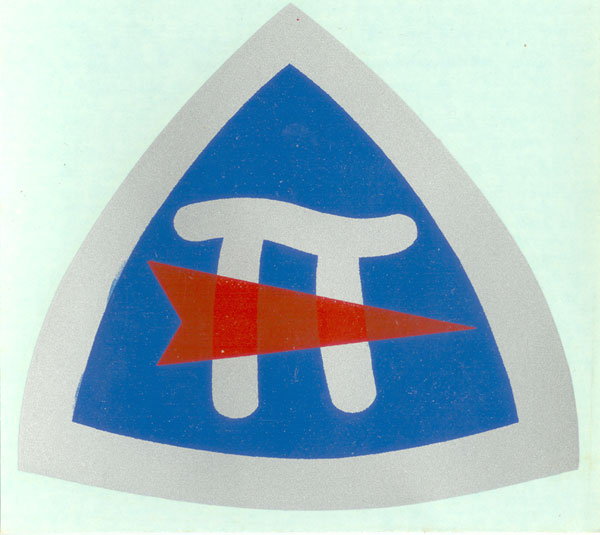
Looks like a Vulcan merit badge.
And this substitution announcement saying that actress Guylaine Guy will assume the role of La Mome Pistache.

I think this was from a 1950s production of Cole Porter’s Can-Can. There’s a picture of her on a French-language site devoted to French-Canadian performers here.
New Yorker article: Twilight of the Books
The Dec 24/31 New Yorker published an interesting essay by Caleb Crain on the changing state of literacy and what it will mean to our culture if people stop reading books or it becomes only an esoteric pass-time for the elite.
This passage the discusses the difference between the oral and the literary mind-set:
Whereas literates can rotate concepts in their minds abstractly, orals embed their thoughts in stories. According to Ong, the best way to preserve ideas in the absence of writing is to “think memorable thoughts,” whose zing insures their transmission. In an oral culture, cliche and stereotype are valued, as accumulations of wisdom, and analysis is frowned upon, for putting those accumulations at risk. There’s no such concept as plagiarism, and redundancy is an asset that helps an audience follow a complex argument. Opponents in struggle are more memorable than calm and abstract investigations, so bards revel in name-calling and in “enthusiastic description of physical violence.” Since there’s no way to erase a mistake invisibly, as one may in writing, speakers tend not to correct themselves at all. Words have their present meanings but no older ones, and if the past seems to tell a story with values different from current ones, it is either forgotten or silently adjusted. As the scholars Jack Goody and Ian Watt observed, it is only in a literate culture that the past’s inconsistencies have to be accounted for, a process that encourages skepticism and forces history to diverge from myth.
I’ve never read a better explanation for Bush’s second term.
It isn’t an entirely one-sided, pro-literary argument however. Cain also hi-lights findings from a 1974 Soviet study that defined ways of seeing the word that are more available to the pre-literate:
Luria found that illiterates had a “graphic-functional” way of thinking that seemed to vanish as they were schooled. In naming colors, for example, literate people said “dark blue” or “light yellow,” but illiterates used metaphorical names like “liver,” “peach,” “decayed teeth,” and “cotton in bloom.” Literates saw optical illusions; illiterates sometimes didn’t. Experimenters showed peasants drawings of a hammer, a saw, an axe, and a log and then asked them to choose the three items that were similar. Illiterates resisted, saying that all the items were useful. If pressed, they considered throwing out the hammer; the situation of chopping wood seemed more cogent to them than any conceptual category. One peasant, informed that someone had grouped the three tools together, discarding the log, replied, “Whoever told you that must have been crazy,” and another suggested, “Probably he’s got a lot of firewood.” One frustrated experimenter showed a picture of three adults and a child and declared, “Now, clearly the child doesn’t belong in this group,” only to have a peasant answer: “Oh, but the boy must stay with the others! All three of them are working, you see, and if they have to keep running out to fetch things, they’ll never get the job done, but the boy can do the running for them.”
It’s an interesting (and fairly depressing) read. Check it out here.
Famous Mountaineer Bookplate
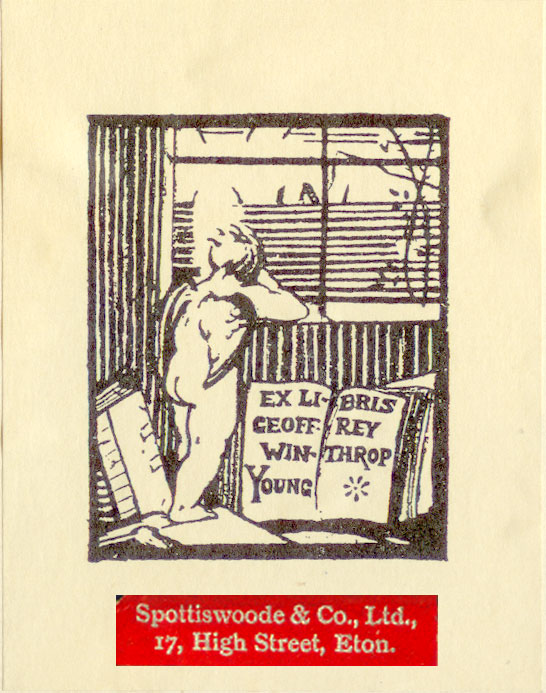
I found this bookplate–“Ex-libris Geoffrey Winthrop Young”–in a copy of Tudor Tracts 1532-1588, Archibald Constable and Co, 1903. I was tempted to remove it for my collection but I did a little googling first and it turns out Young was a famous mountaineer, author and poet.
Excerpted from wikipedia:
“Young made many new and difficult ascents in the Alps, including noted routes on the Zermatt Breithorn (the “Younggrat”), the west ridge of the Gspaltenhorn, on the west face of the Weisshorn, and a dangerous and rarely repeated route on the south face of the Täschhorn. His finest rock climb was the Mer de Glace face of the Grépon. In 1911, with H O Jones, he ascended the Brouillard ridge of Mont Blanc and made the first complete traverse of the west ridge of the Grandes Jorasses, and the first decent of the ridge to the Col des Hirondelles….He was elected president of the Climbers’ Club in 1913…and later president of the Alpine Club.”
He published numerous collections of verse, books on mountaineering and the very entertaining sounding The Roof Climbers Guide to Trinity, “a satirical parody of pompous early alpine guides”.
The book also contains a bookseller ticket from “Spottiswoode & Co., Ltd., 17 High Street Elton” and vocabulary notes on the rear endpaper (possibly in Young’s hand).
Quite a cool find.
Paul Rader Midwood Cover Model
.flickr-photo { border: solid 2px #000000; }.flickr-yourcomment { }.flickr-frame { text-align: left; padding: 3px; }.flickr-caption { font-size: 0.8em; margin-top: 0px; }

Girls Dormitory (Midwood F343) 1963 AUTHOR: Joan Ellis ARTIST: Paul Rader, originally uploaded by Hang Fire Books.
While uploading a new batch of covers to flickr, I noticed that the woman in the background of this Paul Rader painting was done using the same model/photograph as in this 1964 Rader cover I posted previously.
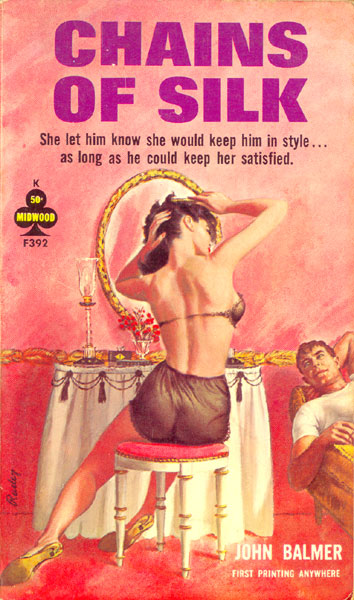
Looks like a new painting rather than over-painting or art director recycling as you frequently see on these covers. It’s an interesting glimpse into Rader’s artistic process.
Lots of fresh cheesecake in my Pulp Fiction Cover Gallery. You can subscribe to an RSS feed of my covers here if interested
(this is separate from/in addition to the regular blog feed) .Ririhong Netslice!

Alice found this Ririhong Netslice in the dollar store down the street. It’s replaced both “thing-a-ma-jig” and “doohickey” in my vocabulary.
I think it perfectly illustrates why China is kicking our ass economically. They can make a closet organizer sound like a finishing move in Mortal Combat…and tweak my patriotism while they’re at it.
 Hang Fire Books