I have a new post at the Bookshop Blog on presenting yourself to a book client and how to spin the occasional awkward question. Check it out here.
Hangman Bookplate
I found this bookplate some time ago (before I started collecting or bookselling) but I just turned it up in the move.
It has a great threatening hangman / executioner theme:
This boke is one thing
The halter another;
He that stealeth the one
May be sure of the other.
The halter another;
He that stealeth the one
May be sure of the other.
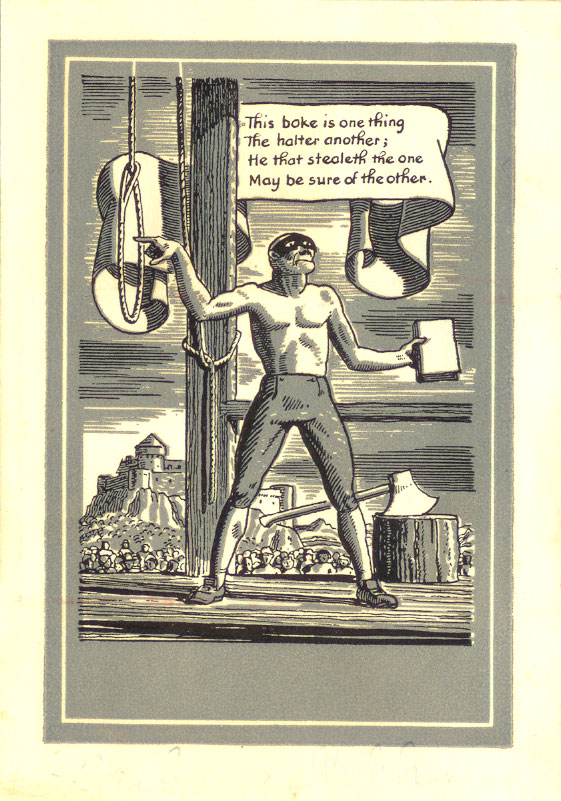
An eBay seller credits this to Rockwell Kent “commissioned and published by the Antioch Bookplate Company, Yellow Springs, Ohio, in 1950.” Barbara Gelhard (?) is faintly penciled in the lower margin.
This next is a child’s homemade bookplate by “Shirley Jean, 1929”:
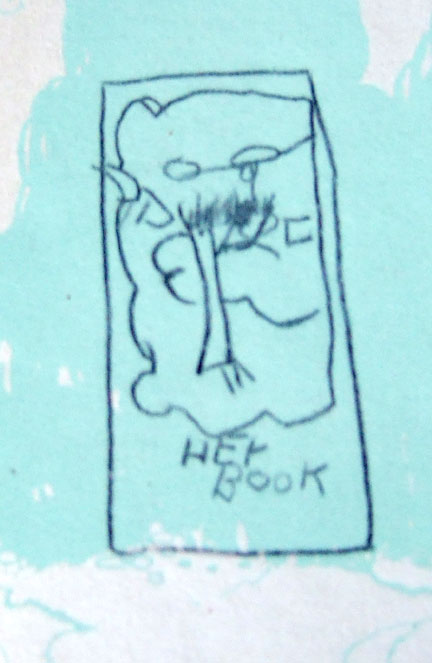
Found in the rare 1920s children’s book The Lost Princess: A Fairy Tale of Marie Queen of Roumania. I wonder if Shirley was copying her parents bookplate or if this was her own creation.
I love finding signs in children’s books that the owner grew into a true bibliophile. I once found a library-like pocket made out of construction paper and held in the book with cartoon animal stamps. Very cute.
New Digs
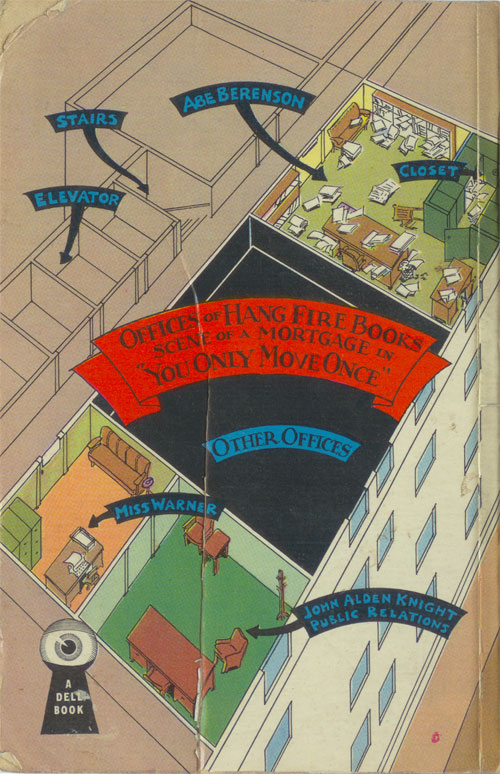
So it came right down to the wire but the last papers were filed, frightening amounts of money changed hands and Alice and I are finally in our new apartment.
The neighborhood is great–Ditmas Park is supposedly one of the most diverse in the country. It’s right between two trains. There’s a public library 20-yards away, numerous interesting restaurants, a coffee and book shop (Vox Pop), 24-hour delis, a food co-op…pretty much everything a demanding and spoiled New Yorker needs.
I wanted to do a mock Dell Mapback with our actual floorplan but after 2 hours on the fun but trying Google Sketchup, I gave up. Maybe we’ll save it for the housewarming party.
Web of Women
.flickr-photo { border: solid 2px #000000; }.flickr-yourcomment { }.flickr-frame { text-align: left; padding: 3px; }.flickr-caption { font-size: 0.8em; margin-top: 0px; }

Web of Women (Soft Cover Library S95300) 1963 AUTHOR: Will Dare ARTIST: (unknown), originally uploaded by Hang Fire Books.
Not a bad painting but the blond looks like she could use a little Endust.
Bookseller Ticket Collection Grows by Leaps and Bounds
Bookseller Sarah Faragher of Sarah’s Books in Bangor, Maine made me a generous gift of a fat envelope of bookseller tickets (doubles from her collection).
Here are a few of my favorites:
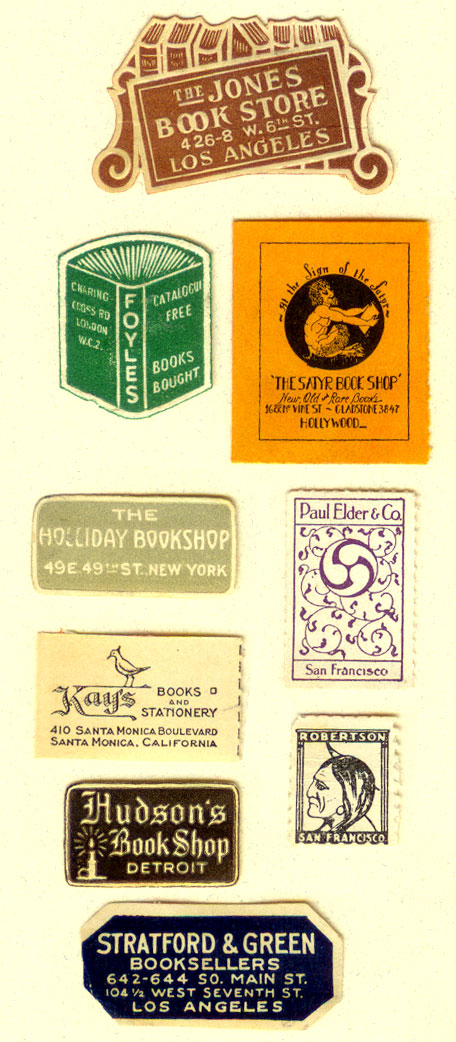
She also offered useful advice on extracting these little buggers.
This has already saved me hours of heartbreak and disappointment. Check out Sarah’s blog. She posts on running her dream business, books about books, landscape painting and nature. It’s always a nice contrast from the mean streets of NYC bookselling.I find that the easiest way to get tickets out of books is this (if they don’t just pop out because the glue is so old): wet a small square of paper towel with enough water so if you squeezed it out water would be visible, then fold the bit of paper towel up until it’s the same size as the ticket you want to remove, put it over the ticket and let it sit for a few minutes. The water will soak into the ticket and loosen the glue, then the ticket will almost always (unless it’s foil) let go very easily. Set the ticket aside to dry off, leave the book open to dry, too. It doesn’t take long and it really works. Same technique for removing book plates, but I’ve seen people use larger damp pieces of felt for that. After the ticket dries I usually write on the back of it the date of the book it came from, just to get an idea of when that bookseller was in business. Or if someone else sends me tickets I write their name on the backs. All in pencil of course…
Anyone have any photos or know anything about The Satyr Bookshop of Hollywood, CA? All I’m Googling is that the store was designed by architect Julius Ralph Davidson who apparently worked in the Beaux-Arts style, created sets for Cecil B. De Mille and designed famous nightspots: The Cocoanut Grove (Hollywood) (pictured below) and The High Hat Restaurant (LA).
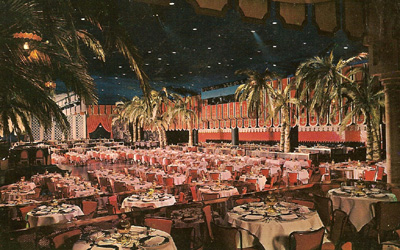
More bookstores should be designed like nightclubs says I, with shady mob ties and Paris Hilton slagging it up in the poetry aisle and stumbling out at 4AM…sorry, I’m drifting.
UPDATE:
A commenter left a useful link from the Rara-Avis Archives containing more info on the Satyr Book Shop.
–From the LA Times magazine section about the 81-year-old Musso & Frank restaurant:
Two remarkable bookstores within a block or so of Musso’s made the Grill an even more attractive hangout for writers. Faulkner, Chandler and Aldous Huxley often browsed at Louis Epstein’s Pickwick Bookshop (opened in 1938). Stanley Rose’s store, literally next door to Musso’s, was a more social place, where writers drank whiskey and swapped stories with the Texas-born bookseller. Musso’s served as the Rose store’s unofficial banker; patrons of both establishments moved back and forth freely in (as Starr wrote) “a nonorganized movable feast.”
An earlier store in which Rose had been a partner, the Satyr Bookshop on Vine, was busted for pornography; it inspired the salacious Bennett’s Bookshop in Raymond Chandler’s 1939 novel, “The Big Sleep.” (Rose’s defense lawyer on the porno charge was Carey McWilliams, whose nonfiction work “Southern California Country: An Island on the Land” in 1946 inspired its own L.A. fictions, notably Robert Towne’s script for “Chinatown” in 1974.)
Thompson, the pulp-noir master (“The Killer Inside Me,” “The Getaway”), lived four short blocks from Musso’s and used the Grill as a virtual office throughout the ’60s, according to biographer Robert Polito. The old writer favored the pot roast special and the zucchini Florentine, washing them down with Jack Daniel’s and Heineken chasers. At Musso’s, Thompson played the hard-bitten raconteur, spinning tough yarns to an eager audience of one or two. And in a booth at Musso’s, he made deals and signed papers with sharp young producers, acts he later regretted.
This sounds like the most hard-boiled bookstore ever. (Thanks Diana!)
Piggies
Evil Friendship by Vin Packer
.flickr-photo { border: solid 2px #000000; }.flickr-yourcomment { }.flickr-frame { text-align: left; padding: 3px; }.flickr-caption { font-size: 0.8em; margin-top: 0px; }
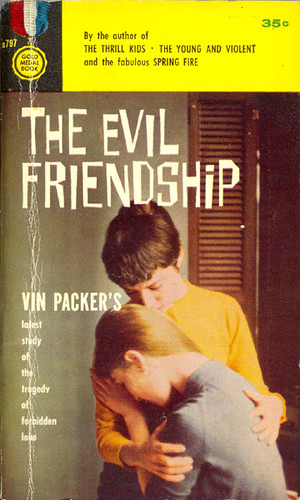
Evil Friendship, The (Gold Medal S797) 1958 AUTHOR: Vin Packer (aka: Marijane Meaker) ARTIST: (unknown), originally uploaded by Hang Fire Books.
I recently finished The Evil Friendship by Vin Packer (pseudonym of Marijane Meaker) in preparation for her appearance at the 2007 NY Paperback Expo. Sadly she couldn’t make the show but the book was great, so no hard feelings.
Evil Friendship is based on the 1950s New Zealand Parker-Hulme murder case in which two school-girls–joined in an obsessive relationship–murder the mother they see as a threat to their happiness. This case was the inspiration for Peter Jackson’s Heavenly Creatures and an incident from the life of a widely-read mystery novelist (who probably gets enough internet grief so you’ll have to google her yourself).
My only previous knowledge of the case came from Heavenly Creatures so I can’t say how close this book cleaves to the facts, but there are some interesting differences from the film. Meaker relocates the girls to rural England and introduces other lesbian figures into their lives. One a sadistic school-girl who joys in the fact that her ex-crush slit her wrists in despair at being dumped, the other an older butch gym coach who’s filled with sad longing and is lead-on and emotionally black-mailed by the students.
It’s interesting to see the girls in this more explicitly lesbian context and–stuck between these archetypes–it’s understandable that they need to escape into a fantasy world. And as much as I like Heavenly Creatures the fantasy world Jackson creates was its biggest weakness. The animated clay sequences are too detached from the rest of the film and the effects haven’t aged well. Meaker gets the escapism across in a much subtler way that feels much more tied to the girls lives, class and the other characters in the novel.
Evil Friendship is a good read if you’re interested in early lesbian fiction or psychological suspense in the Highsmith or Simenon vein. I’ll definitely pick up more of Meaker’s work. Given the variety of her titles (and pseudonyms) she seems to be an extremely versatile talent.
Shop my Gay/Lesbian and Vintage Paperback catalogs.
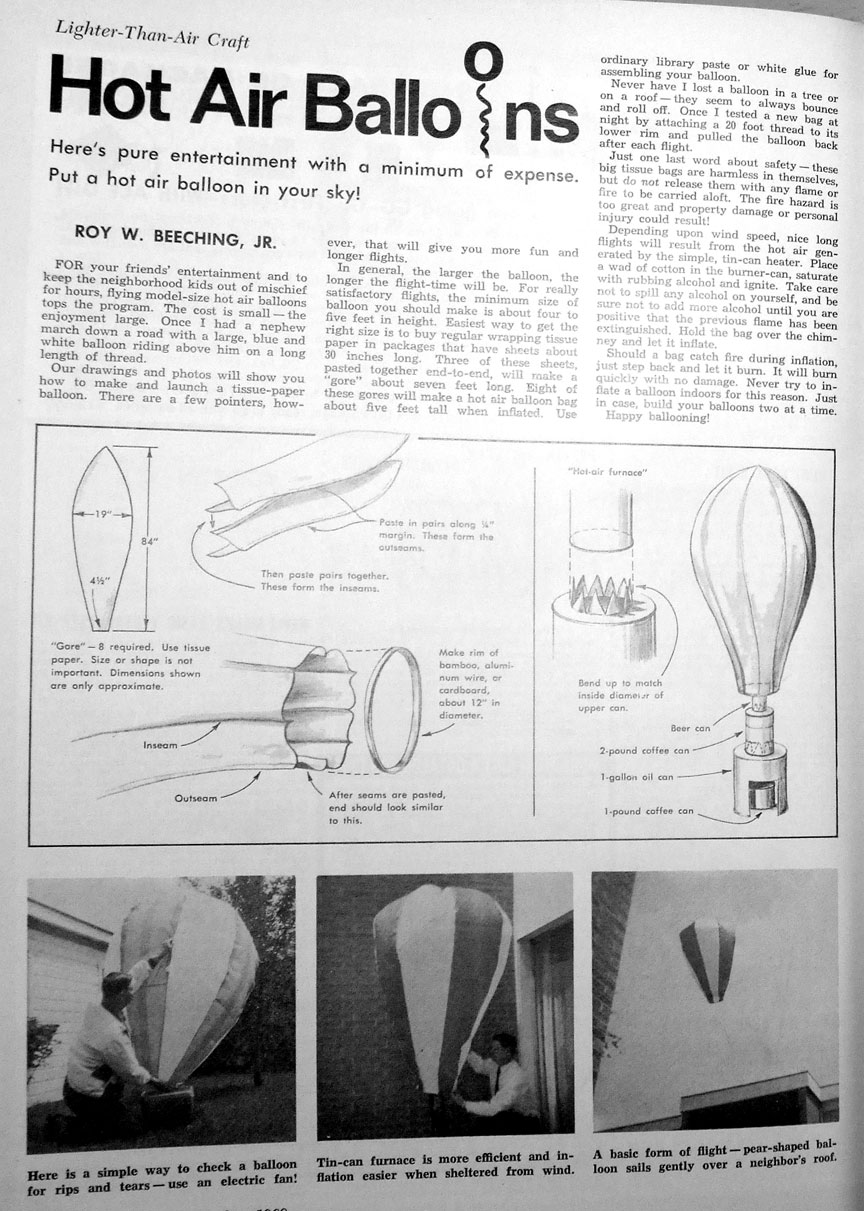
Tissue and Beer Can Hot Air Balloon
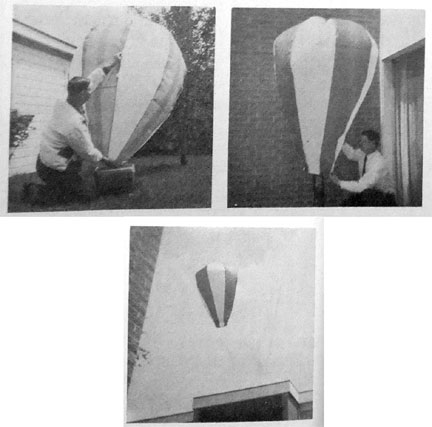
I found this cool and simple plan for a hot air balloon and inflater in a vintage issue of American Aircraft Modeler. Tissue paper a couple of tin cans and you’re ready to go. Looks like a lot of fun.
Here’s the full plan:
Tissue Paper and Beer Can Hot Air Balloon
Plan by Roy W. Beeching, Jr.
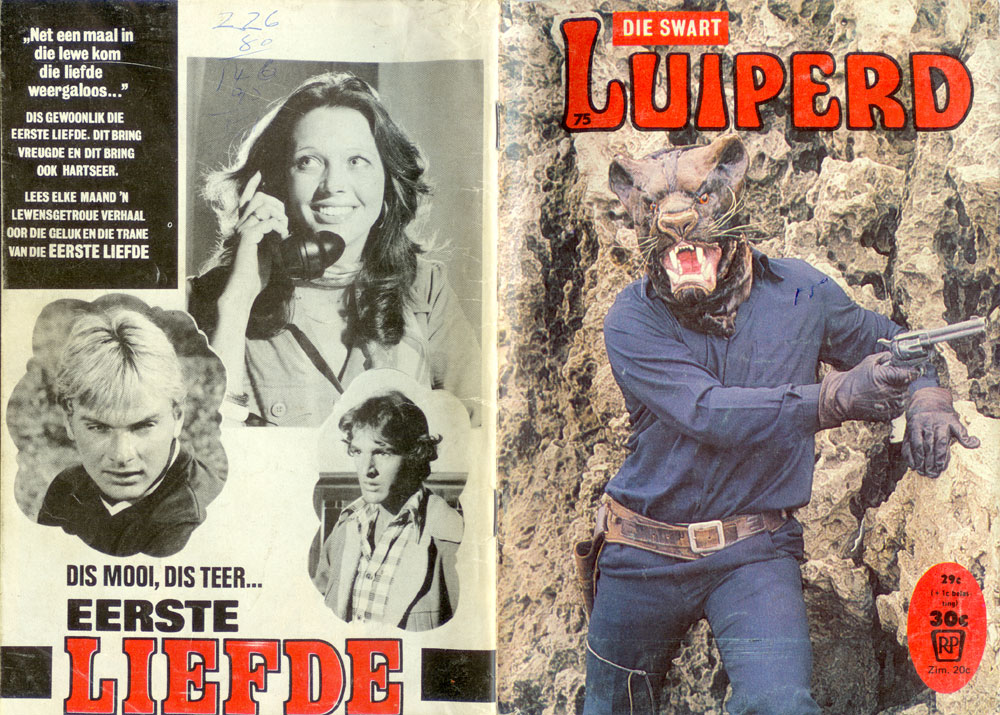
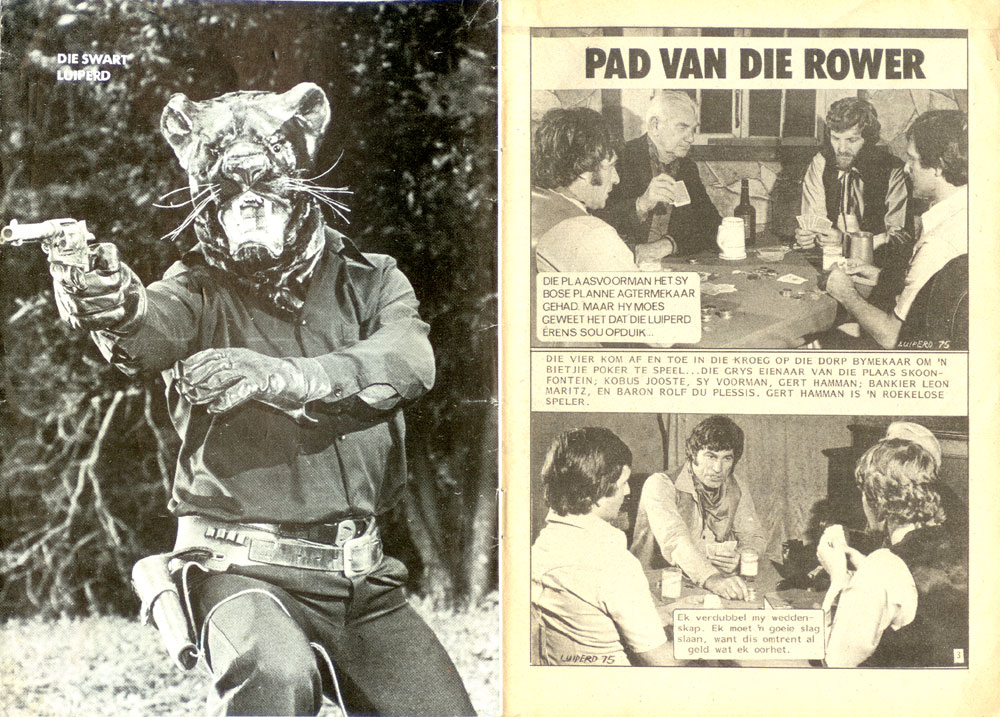
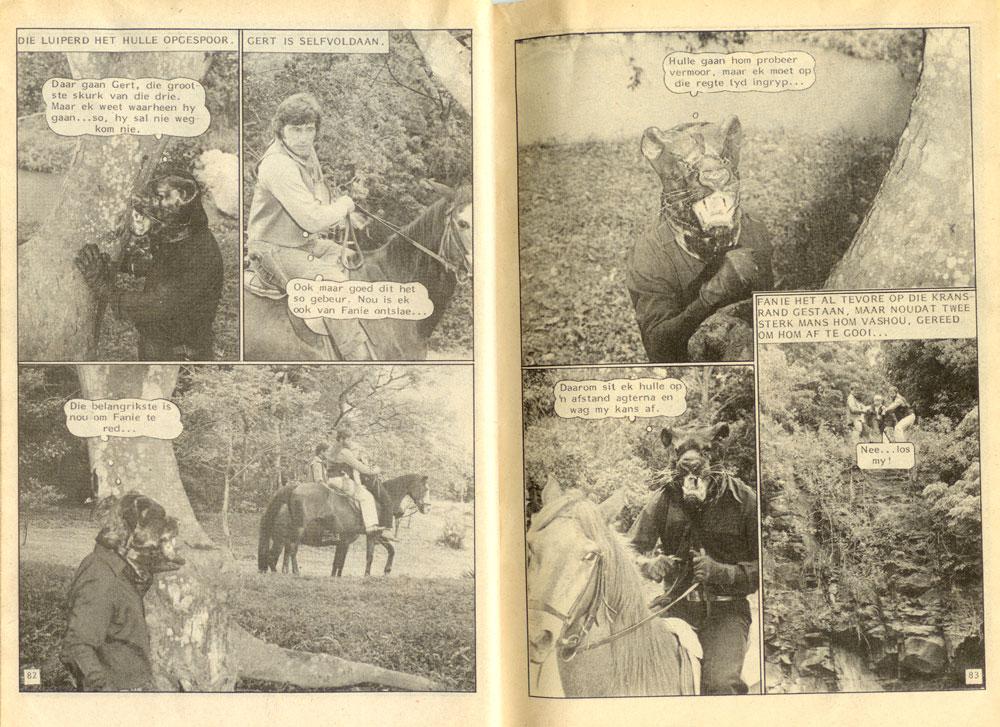
Die Swart Luiperd
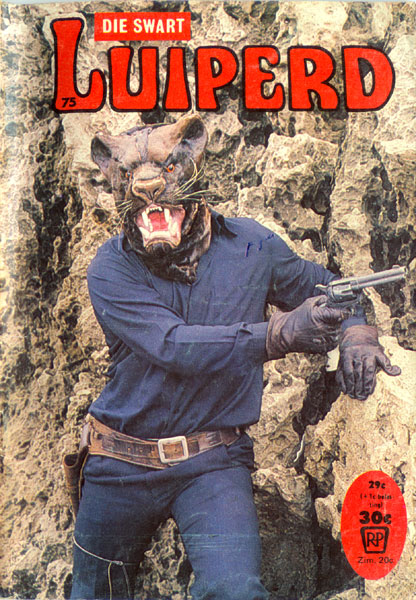
I found this digest-sized photo-novel (comic book format but B+W photos with word bubbles) featuring the cat-masked “Swart Luiperd” at the recent NYC Collectable Paperback & Pulp Fiction Expo (which was great BTW, but I was too busy digging through boxes and juggling want lists to blog it properly).
There was a huge stack of digests featuring this character going at least back into the 40s, and spanning a number of popular children’s genres (jungle adventure, western, mystery, etc).
Here’s a few page spreads:
Die Swart Luiperd 1
Die Swart Luiperd 2
Die Swart Luiperd 3
I can’t pinpoint the language and I can’t find anything about the character. Seems like he was in the Zorro, Phantom tradition (though he may have flirted with super-crime–like Diabolik and Kriminal–at low points in his career).
The publication data isn’t very legible but it seems to be South African in origin “Republikeinse Pers…Suidkuswegg 1322…Republikeinse Nousagenentskap, Empirewegverlenging S. Aucklandpark, Johannesburg”.
Anyone know more about the character?
Little Sparks and the Electric Song

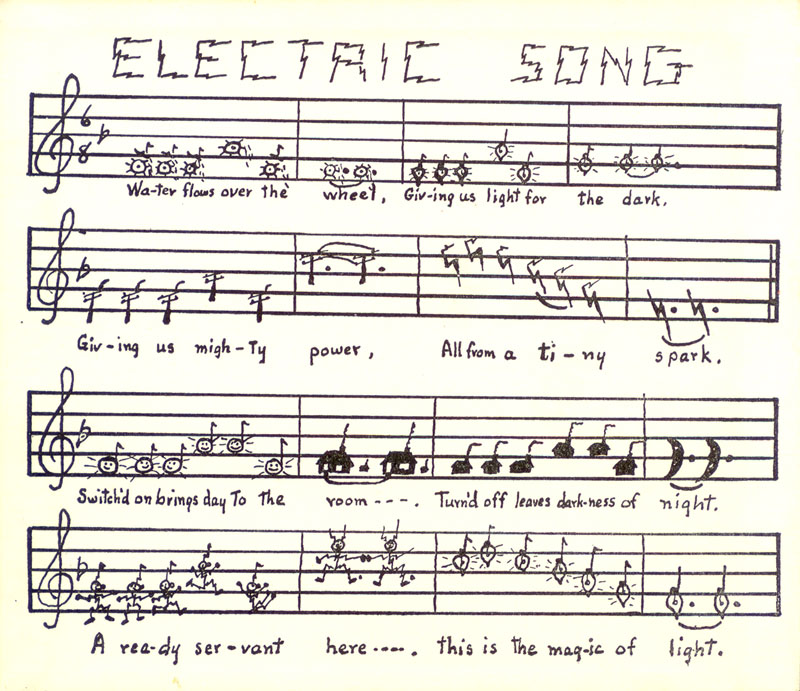
Another cool find from the WLGS : Sparks and Little Sparks (Albert Whitman and Co., 1940), a children’s book on maintaining the electrical grid (click on images for larger version).
I sing this every day before I turn on the computer.
 Hang Fire Books