Sexy Picture

Kirsten Berg, over at the Powell’s Books Blog recently posted on the Care and Feeding of Your Books and included this stirring “visible” photo of “A Nicely Packed Box” of books.

Delicious. This is my new desktop background.

Even as a green, untrained youth, I always packed boxes like this. I came to books from a very OCD, comic-book collector’s mentality so I have my once near-complete collection of the appearances of Dr. Doom to thank for my formidable packing chops.

UPDATE: A reader asked that I explain why this is proper way to box books. This is a bit like explaining how to breathe for me but I’ll give it a try.

The horizontal stacking distributes the pressure evenly. It keeps the boards flat and prevents/cures warping.

The vertical books in between fill the void space in the box which minimizes shifting and prevents the corners and page edges of the horizontal books from bumping together. The vertical books should always go on end (as if on a bookshelf). If you place them open-side down, eventually the weight of the text block will weaken the hinges and binding.

The vertical books should never extend higher than the horizontal stacks, otherwise the box you place on top will mash them.

Always fill your boxes to the top edge (but not beyond) otherwise the boxes will compress and split when stacked. If you don’t have enough books to fill your last box, mark on the outside that it should go on top.

If you any have large, folio volumes keep them together. Mixing them into boxes with average size books can apply uneven pressure and deform the larger books

Seal your boxes with tape and try to avoid the “criss-cross” method (which has caused me to destroy a delicate paperback or two).

If you have to stack books in a damp/musty environment for any length of time:
A) don’t
B) keep them off the floor/ground on a table or palette
C) Add desiccant packets
D) Get them back into a humidity controlled environment ASAP

Lastly (and this isn’t pictured) if you have numerous mass market or trade paperbacks of the identical trim size, alternate the direction of the books in your stacks (ex: five facing one way, five the opposite, etc). The spine edge is slightly thicker in paperbacks, alternating corrects for this and make for more even stacks (and healthier books).

Dealbreaker Books

Invited into a home for the first time, a book lover will take great pleasure in combing through the owner’s bookshelves. Some do it brazenly, some wait for the host to get up and refill the drinks, but we all do it. That peek into the psyche is irresistible.

But there is risk involved. Have you ever found a title that you just can’t accept? a book that makes your skin crawl? a book that creates serious misgivings about going forward with the dinner party/new friendship/one-night stand that you thought was in the cards?

These are dealbreaker books. And I want to know what yours are….and why.

I’ll start:

Ayn Rand. If someone has more than one Ayn Rand title and they appear well-thumbed/hi-lighted/color-tabbed, I’m out of there. It has to be at least two though, just one could be a youthful folly or a misguided recommendation. Of course, I’ve never read her but the association with Reaganomics, 80s excess, and free-market devil cults turns my stomach. Sure, I’m a selfish bastard too but I don’t make a big thing out of it.

Okay, your turn…

More Galleries

I just added several more book galleries, titled the photos (including book title, year and cover artist when known) and broke them into semi-logical sets. Have a looksee if you’ve some time to kill.

I added a permanent link to these Flickr sets in the sidebar at right (below “About Me”). I’ll quietly make new additions as I find things

NOTE: I realize the 3/4, askew angle isn’t ideal for showing-off cover art but these were existing photos, meant to indicate book condition as much as design. In the future I may take photos straight-on if I include them in the gallery.

ALSO NOTE: Many of these faithful and adorable books are available for adoption. I would let them go to good homes in exchange for donations to continue my good work. Search the book titles here if you’re interested in something.

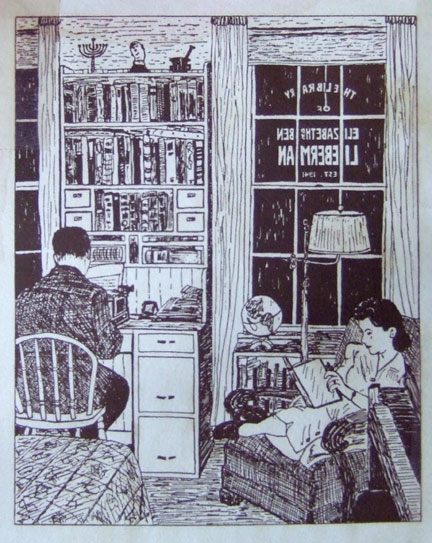
Elizabeth and Ben Lieberman Bookplate 1941

Just found this beautiful and homey bookplate inside a collection of short film scripts called One-Reel Scenarios from 1938.

Looks like it was drawn from a photo. I love that the owner info “The Library of Elizabeth and Ben Lieberman, est 1941” appears backwards since it’s written on the outside of the library window. I played with this on my bookmark/logo but I wasn’t brave enough to force people to read it backwards.

I haven’t Googled too deeply, but it looks like the Liebermans were the proprietors of the Herity Press that specialized in books about printing. Also they were the one time owners of the Kelmscott/Goudy Albion iron hand printing press that was used by famed designer William Morris.

Pulp Fiction Cover Gallery


I just created a Flickr set of my favorite pulp fiction and comic covers that have passed through the store. I’ll add to it regularly and I may eventually organize and add tags. Right now it’s about 170 covers in one big set.

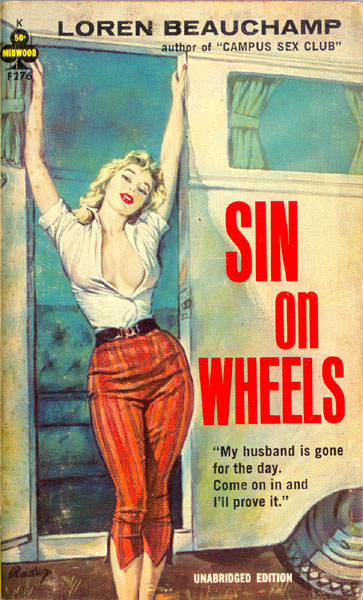
Speaking of pulp fiction If you haven’t seen Black Snake Moan drop everything and rent it now! Christina Ricci plays the greatest Jailbait Trailertrash Nympho ever captured on film…and I would know.

DailyLit

I just subscribed to daily installments of Middlemarch and Democracy in America (Alexis De Tocqueville) via RSS feed.

Dailylit offers email and RSS subscriptions to classics (and new Creative Commons-licensed works) in digestible, web-friendly chunks. I read the first installment of each and the texts were legible and ended at sensible points.

I tried this approach before with Pepys diary but it was in blog format, pre-RSS and I didn’t stick with it. I may chuck these eventually and pick up the real books but for now it’s a good way to get into substantial books that I’ve been neglecting.

Let’s see if they have a suggestion page so I can request 1001 Nights…

Thanks to Another 52 Books for the link.

Charge More

Michael Lieberman at Book Patrol posted about penny bookdealers yesterday. It made me think about ways that more…ambitious? professional? upmarket? booksellers (basically people who don’t want to spend every waking moment throwing Barbara Cartlands into puffy envelopes) can separate themselves from that first screen or two of seductively cheap listings.

Here’s what I came up with:

1. Describe the book in your hand–Most penny dealers have one description. They’re selling some platonic ideal of a used book that may or may not contain underlining; come with the CD; have a dustjacket; benefit someone in Africa; be covered in cat barf. If you accurately describe the condition of your item, the choosier buyers will seek you out.

2. Take a picture–This goes hand in hand with describing the book. If a venue allows for the uploading of images, provide them. This will make your listings pop. ABE has a drop down menu that lets a buyer filter for books with bookseller supplied photos. On eBay, an item with a gallery image takes up more screen space–that’s a good advertising strategy. I even take pictures of low dollar books if they’re aesthetically pleasing. You want to lure the buyers in with attractive and affordable sentimental favorites. It’s a gateway drug.

3. Give complete information–Who’s the illustrator/cover artist? Who wrote the preface/introduction/afterword? Is the title descriptive enough? (if not, add keywords) Is it a first printing/edition? You can’t anticipate every reason a customer seeks out a book, so give them everything you can think of. I’ve even sold books to descendants of previous owners because I transcribe full inscriptions.

4. Package carefully and ship promptly–Protect the items that you sell. Make sure they arrive in the same condition that you so carefully described.

5. Follow up–Send a shipping confirmation. My standard e-mail repeats the estimated shipping times, flogs my store and blog, requests feedback (with links), and offers to answer any questions. This e-mail reassures the customer that they haven’t thrown their money down a black hole and it probably heads off most questions

6. Charge more–If you always go for the lowest price, you WILL be undercut and you’re contributing to the devaluing of the item (and the book trade in general). If you take care in describing your product and provide a positive customer experience, then charge for the service. I habitually charge 25-50% more than other booksellers who have less detailed descriptions and/or lower ratings and it hasn’t hurt my sell through percentage at all.

Buyers will eventually get burned or have poor experiences with the penny bookdealers (a profit margin of $.60-$1.00 per sale doesn’t allow for much time or care). But when the buyers come back (assuming they do come back) show them that it doesn’t always have to be that way. Train them to skim right past all the $.01s and find an honestly described product at a reasonable price.

Ephemera Wall

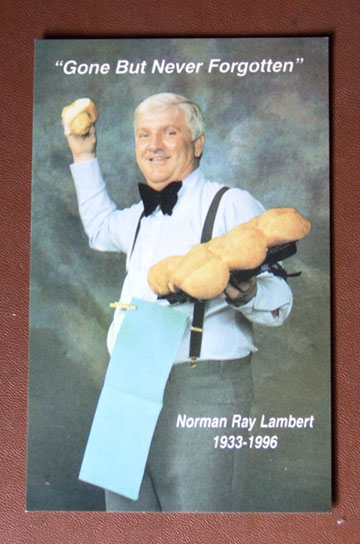
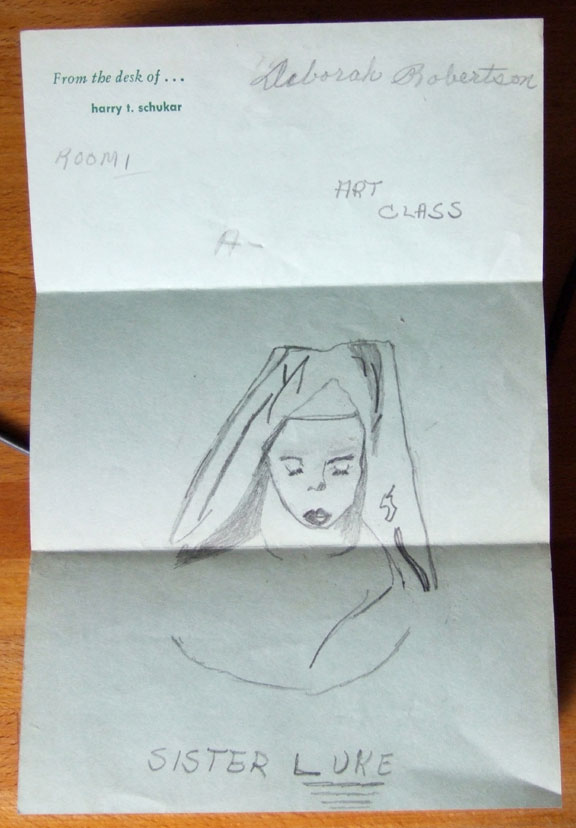
Found two more nice items for my ephemera wall. Both were from a copy of Cluny Brown by Margery Sharp (famed for The Rescuers).

The first is an advertising/memorial postcard for Norman Ray Lambert (1933-1996). Lambert was the owner and mascot of LAMBERT’S CAFE “Home of Throwed Rolls”, a small chain of restaurants in Missouri and Alabama where apparently you can still have hot rolls hucked at you.


The second item is a nice pencil portrait of a nun–“Sister Luke”–that earned the artist an A-.